
 501, Fifth Avenue, Suite 805 New York, NY 10017
 info@techwize.com
 +1 (949) 887-0154
 TechWize
In 2026, almost every company claims to "do AI." Far fewer can prove it works in production. Recent research shows that the vast majority of enterprise AI initiatives still fail to move the needle on profit and loss, with only a small fraction of organizations extracting real, measurable value from their investments (source: MIT Project NANDA, 2025).
That gap is not a technology problem. It is a partner problem.
Choosing the wrong AI Development Company often looks like this: a polished demo that wows the leadership team, a six-figure invoice, and then months of silence as the "pilot" quietly dies in a sandbox. No integration with real data. No compliance review. No plan for what happens when the model is wrong. The business is left with a slide deck instead of a system.
The companies winning with AI in 2026 are doing the opposite. They are partnering with firms that treat AI Development Solutions as production engineering, not magic. They ask hard questions before signing a contract, demand to see systems running in live environments, and hold vendors accountable for outcomes, not just outputs.
This guide breaks down what actually separates a strong AI Development Services provider from a demo factory, how to evaluate one, and which companies (including TechWize) are setting the standard in 2026.
What Are the Core Components of AI Development Solutions
Before evaluating any vendor, it helps to understand what a complete AI Development Solution actually includes. Too many businesses buy a model or a chatbot and call it "AI transformation." A real solution is layered, and each layer matters.
At the foundation sits data architecture: the pipelines, storage, and governance that feed an AI system clean, current, and compliant information. Without this layer, even the best model produces unreliable results, a classic case of garbage in, garbage out.
On top of that sits the model and orchestration layer. This is where large language models, machine learning models, and agentic frameworks like LangGraph, CrewAI, and AutoGen actually coordinate to perform tasks, whether that is answering customer queries, processing claims, or routing support tickets.
Above that is the application layer: the interface, workflows, and integrations that connect AI capabilities to the tools your team already uses, such as CRMs, ERPs, EHRs, or internal dashboards.
Finally, and most often skipped, is the governance and operations layer. This includes monitoring, human-in-the-loop escalation, compliance controls, and continuous improvement after launch. Industry data from 2026 shows that customized AI tools built on an organization's proprietary data reach production roughly twice as often as generic internal builds (source: MIT Project NANDA, 2025). That gap exists almost entirely because of this final layer.
A genuine AI Development Solutions provider builds and owns all four layers, not just the flashy middle one.
4 Types of AI Development Services for Your Business
Not every AI vendor is built the same way, and understanding the category a company falls into will tell you a lot about what to expect.
Custom AI Development Companies
These firms build bespoke models, agents, and pipelines tailored to your data and workflows. They tend to be the right fit when your use case is specific to your business, such as a proprietary scoring model, a custom voice agent, or an internal copilot trained on your documentation. The tradeoff is longer timelines and higher upfront investment, but the payoff is a system that fits your business rather than the other way around.
Platform-Based or SaaS Configurators
These are pre-built AI products that you configure rather than build from scratch; think AI-powered helpdesk tools, marketing copy generators, or analytics dashboards with AI features baked in. They are fast to deploy and low cost, but customization is limited, and you are dependent on the platform's roadmap.
Enterprise Consultancies with AI Practices
Large global consulting firms have built AI divisions on top of their existing strategy and arms. They bring scale, governance frameworks, and deep industry relationships, which makes them a strong fit for large, regulated enterprises with complex, multi-year transformation programs. The tradeoff tends to be cost and speed; engagements often run into the millions and can take longer to move from strategy to live deployment.
Specialist Firms for SMB and Mid-Market
These firms focus on small and mid-sized businesses that need production-grade AI without enterprise-level budgets or timelines. They typically combine custom development with reusable frameworks, allowing them to deliver working systems in weeks rather than quarters. For most growing businesses, this is where the best value lives: enough customization to matter, without the overhead of an enterprise engagement.
Industries Getting the Highest ROI from AI Development Services
AI ROI is not evenly distributed. Some industries are seeing transformational results, while others are still in pilot purgatory.
Healthcare and life sciences are leading the pack. Active AI use in this sector has reached around 63%, with another sizable share piloting initiatives, and organizations are reporting measurable ROI from applications like medical imaging and drug discovery (source: NVIDIA State of AI in Healthcare and Life Sciences, 2026). More than half of medical technology companies report seeing returns specifically from AI in imaging (source: NVIDIA State of AI in Healthcare and Life Sciences, 2026).
Financial services, particularly banking, insurance, and wealth management, continue to lead in adoption share, driven by fraud detection, underwriting automation, and AI-assisted compliance checks (source: Netguru AI Adoption Statistics, 2026).
Manufacturing is shifting from simple cost-saving pilots toward a broader value model that includes revenue gains, capital efficiency, and risk reduction, driving the adoption of Physical AI in manufacturing automation to achieve what is often referred to as Total Business Value (Source: Tech-Stack AI Adoption in Manufacturing Report, 2026).
Retail has become one of the most commercially mature sectors, with AI engagement reaching roughly 91% across digital commerce, supply chain, and in-store operations (source: DesignRush AI Statistics, 2026).
Across professional services, knowledge management functions in legal, consulting, and compliance are seeing some of the fastest visible gains, with around 58% reporting measurable improvements in this area (source: DesignRush AI Statistics, 2026).
The common thread across every high-ROI industry is the same: these organizations are not deploying generic tools. They are working with partners who build on proprietary data and embed AI directly into existing workflows.
Top AI Development Companies for Boosting Your ROI
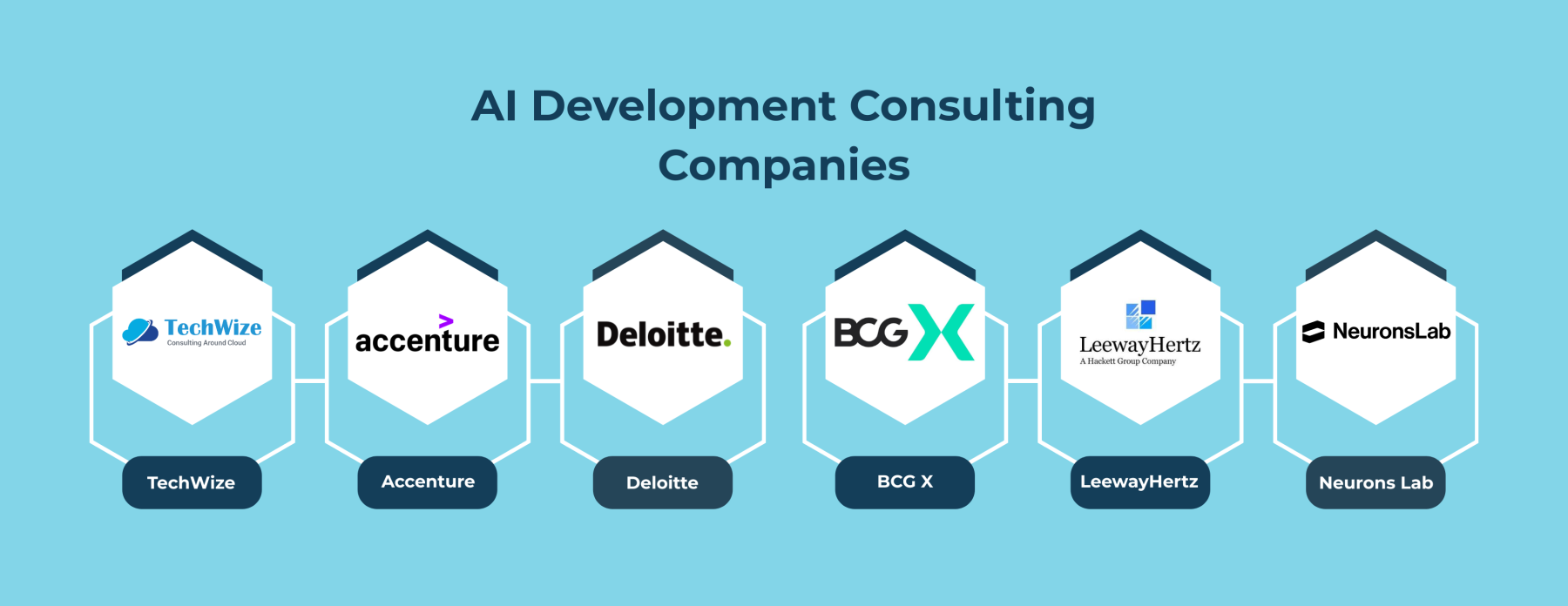
If you are scoping out an AI Development Company shortlist for 2026, these six firms represent a strong cross-section of the market, from boutique specialists to global giants.
1. TechWize
TechWize Official Website stands out among AI development companies by helping mid-market and enterprise organizations move beyond experimental AI pilots and build scalable, production-ready AI solutions. With expertise in AI development, automation, LLM applications, and enterprise-grade architectures, TechWize focuses on delivering measurable business outcomes rather than strategy-only engagements.
Key Features:
- Production-Focused AI Development: Builds and deploys practical AI solutions designed to integrate seamlessly with existing business workflows and systems.
- Agentic AI and Intelligent Automation Expertise: Develops AI-powered solutions that enhance decision-making, automate complex processes, and improve operational efficiency.
- Enterprise-Grade Architecture: Prioritizes scalability, security, compliance, and reliable performance for business-critical AI applications.
- End-to-End AI Partnership: Supports businesses throughout the AI journey, from strategy and development to deployment, optimization, and ongoing support.
- ROI-Driven Approach: Focuses on solving real business challenges with customized AI solutions that create measurable value and long-term impact.
With a strong emphasis on practical implementation and continuous improvement, TechWize is a trusted partner for organizations looking to transform AI investments into real business growth.
2. Accenture
remains one of the largest players in enterprise AI transformation, leveraging a global workforce and deep partnerships with major cloud and model providers to support large-scale digital and AI initiatives across industries.
3. Deloitte
built its AI practice around a structured governance framework covering fairness, transparency, accountability, and robustness, an approach that resonates strongly with regulated industries like finance and healthcare (source: CommercePundit Top 10 AI Consulting Companies, 2026).
4. BCG X
operates as the build-and-design arm of Boston Consulting Group, focused on shipping AI-enabled products rather than producing strategy decks alone, with partnerships spanning AWS, Google Cloud, OpenAI, and Anthropic (source: CommercePundit Top 10 AI Consulting Companies, 2026).
5. LeewayHertz
is positioned as a technically deep AI development and consulting firm, delivering engineered solutions including NLP systems, LLM-based products, and automation frameworks for mid-to-large enterprises (source: EffectiveSoft Top 10 AI Consulting Companies in the USA, 2026).
6. Neurons Lab
Specializes in agentic AI for banking, insurance, and wealth management, with a track record of taking projects from concept to production in as little as 8 to 12 weeks for clients in highly regulated environments (source: Neurons Lab Top AI Consulting Firms for FSI, 2026).
Each of these firms occupies a different niche. The right choice depends less on brand recognition and more on whether their delivery model matches your timeline, budget, and compliance requirements, which is exactly what the next section will help you evaluate.
6 Ways to Evaluate an AI Development Company
Picking a vendor based on a sales pitch is how most failed AI projects start. Here is what to actually look for.
1. Production Deployments vs Demos
Ask directly: how many systems has this company taken from prototype to live production, used by real employees or customers, not just shown in a sandbox? Request specific examples with timelines. A firm that can only point to proof-of-concept work is not ready to be your partner.
2. Frameworks and Tech Stack Used in Production
The agentic AI landscape has matured rapidly. By 2026, LangGraph has become a default runtime for production-grade agent orchestration due to its support for state persistence, checkpointing, and audit trails, while CrewAI is favored for role-based multi-agent collaboration and rapid prototyping (source: PE Collective AI Agent Frameworks Compared, 2026). A credible vendor should be able to explain which frameworks they use, why, and how they handle versioning, vector databases, and model swapping without disrupting your operations.
3. Compliance Handling
Data privacy is not optional, especially in healthcare, finance, and any business handling personal information. Ask how the vendor architects consent management, data residency, and audit logging. Deloitte's "Trustworthy AI" framework, for example, explicitly bakes governance into delivery from day one rather than treating it as an afterthought (source: CommercePundit Top 10 AI Consulting Companies, 2026). Your vendor should have an equivalent answer, even if it is not a formal named framework.
4. Escalation and Human-in-the-Loop Design
What happens when the AI gets it wrong, or encounters a situation it was not trained for? A serious AI Development Services provider will design clear escalation paths, where the system hands off to a human, how that handoff is logged, and how edge cases feed back into model improvement.
5. Post-Deployment Monitoring (AgentOps)
AI systems degrade and drift over time as data changes, user behavior shifts, and edge cases accumulate. Ask whether the vendor provides ongoing monitoring, sometimes called AgentOps, covering performance tracking, error recovery, and alerting. Vendors offering durable execution, observability hooks, and rollback capability are signaling they understand AI is a living system, not a one-time deliverable (source: Alice Labs Best AI Agent Frameworks 2026).
6. Engagement Model and Seniority of Team
Finally, ask who will actually be doing the work. Many firms sell you a pitch from senior leadership and then staff the project with junior consultants. Clarify the engagement model upfront: fixed-scope, milestone-based, or time-and-materials, and confirm the seniority and continuity of the team assigned to your project.
5 Checklist Items Before Hiring AI Development Companies
Even with the right evaluation criteria, businesses make the same five mistakes over and over when hiring an AI Development Company.
- Choosing based on demos, not case studies. A demo is built to impress in 15 minutes under ideal conditions. A case study shows how a system performed over months, with real data, real users, and real edge cases. Always ask for the latter.
- Skipping data architecture audits. If a vendor does not want to look closely at your existing data infrastructure before proposing a solution, that is a red flag. AI built on messy, siloed, or non-compliant data will fail regardless of how good the model is.
- Ignoring compliance requirements. Retrofitting compliance after deployment is exponentially more expensive than designing for it upfront, particularly in healthcare, finance, and any business operating across multiple jurisdictions.
- Open-ended time-and-materials contracts. Without clear milestones, deliverables, and exit criteria, time-and-materials contracts can quietly balloon. Insist on phased scopes with defined checkpoints, even within a broader retainer relationship.
- Treating deployment as the finish line. Launch day is the starting line, not the finish line. The highest-performing organizations treat the weeks and months after deployment, monitoring, tuning, and iteration, as part of the core engagement, not an optional add-on.

Stop Settling for AI Demos. Start Seeing Real ROI
Most AI projects never reach production, and the ones that do often stall within months. TechWize builds AI Development Solutions designed for compliance, human oversight, and long-term performance, not just a polished pitch. From custom agentic systems to full AI Development Implementation Services, our team stays with you well past launch day.
Talk to an AI Development ExpertThe Technology Stack Behind Modern AI Development Solutions
The technical foundation of AI Development Solutions in 2026 has converged around a few core layers, even as specific tools continue to evolve.
At the orchestration layer, agentic frameworks like LangGraph, CrewAI, and Microsoft's Agent Framework (the successor to AutoGen) coordinate multi-step reasoning, tool use, and multi-agent collaboration. LangGraph in particular has become a common choice for production systems because of its graph-based architecture, which maps cleanly to requirements like audit trails, rollback points, and conditional logic (source: Medium, ATNO for GenAI and Agentic AI, 2026).
At the data layer, vector databases enable retrieval-augmented generation (RAG), allowing AI systems to ground their responses in your organization's actual documents, policies, and historical data rather than relying solely on a model's general training.
At the model layer, most production systems in 2026 are model-agnostic by design, capable of working with multiple providers such as OpenAI, Anthropic, and Google so that businesses are not locked into a single vendor's roadmap or pricing (source: Medium, ATNO for GenAI and Agentic AI, 2026).
Finally, at the operations layer, observability and control-plane tooling have become essential. Industry analysis increasingly emphasizes that frameworks alone do not govern risky actions before they reach production, which is why pairing an agent framework with policy enforcement, approval workflows, and audit logging has become a best practice for any serious deployment (source: Cordum AI Agent Frameworks Comparison, 2026).
A partner that understands this full stack, not just the model layer, can actually deliver a system you can run, monitor, and improve for years.
TechWize: Leading AI Development Company in 2026
If there is one theme running through every section above, it is this: the gap between AI hype and AI ROI comes down to execution. This is exactly where TechWize has built its reputation.
TechWize approaches AI Development Solutions the way production engineering teams do, starting with a clear-eyed audit of your existing data and systems, designing for compliance and human oversight from day one, and building on proven, model-agnostic frameworks rather than locking clients into a single vendor's ecosystem. Their AI Development Services are structured around phased delivery with defined milestones, so clients always know what they are getting and when, rather than facing the open-ended timelines that plague so many AI engagements.
What sets TechWize apart as an AI Development Company is its commitment to staying with clients past the deployment milestone. Post-launch monitoring, performance tuning, and iterative improvement are built into the engagement model, not sold as a separate add-on later. For businesses that have already experienced the frustration of a stalled pilot or an AI tool that quietly stopped being used six months after launch, this difference matters enormously.
Whether your business needs a custom agentic system, a RAG-powered internal knowledge tool, or a full AI transformation roadmap, TechWize offers the technical depth of a specialist firm with the structured delivery discipline of an enterprise consultancy, without the enterprise price tag or timeline. You can explore their work and approach directly at techwize.com.
Read Similar Blog
How AI Development Solutions Are Transforming Education in 2026
Explore More AI Insights ⬩➤Conclusion: Choosing AI Development Solutions That Deliver, Not Just Demo
The AI Development industry in 2026 is crowded, but the businesses winning with AI are not choosing based on the flashiest demo or the biggest brand name. They are choosing partners who can show production deployments, explain their technology stack in plain language, design for compliance and human oversight from the start, and commit to the long, less glamorous work that happens after launch.
Underneath every agentic framework, vector database, and orchestration layer discussed above sits one constant: Python. Most AI Development Solutions, from custom LLM pipelines to RAG systems and AgentOps tooling, are built and maintained using Python Development, since the language remains the backbone of frameworks like LangGraph, CrewAI, and AutoGen. When evaluating a vendor's tech stack, it is worth confirming their Python Development capabilities directly, as this is often what determines how maintainable, scalable, and future-proof your AI system will be long after the initial deployment.
When you are ready to move from demos to deployment, an AI Development Company like TechWize, built around production outcomes rather than proofs-of-concept, is the kind of partner that turns AI investment into measurable ROI.