
 501, Fifth Avenue, Suite 805 New York, NY 10017
 info@techwize.com
 +1 (949) 887-0154
 TechWize
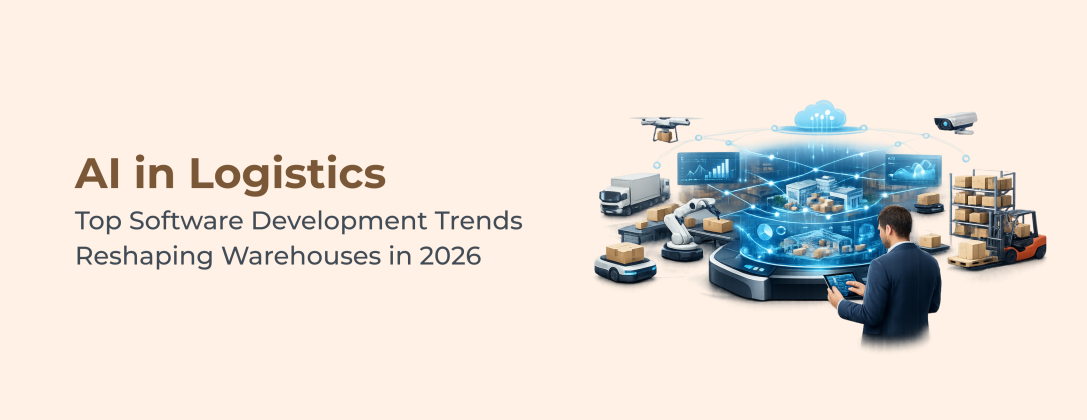
Walk into any warehouse today, and you will notice something different from just a few years ago. Screens do not just display numbers anymore; they suggest actions. Robots do not just move boxes; they coordinate with each other. Cameras do not just record footage; they catch errors before they become costly problems.
This is the reality of AI in Logistics in 2026. The global AI in logistics market was valued at approximately USD 12.23 billion in 2026 and is projected to reach USD 196.61 billion by 2034, growing at a CAGR of 41.50 percent (source: Fortune Business Insights). That kind of growth does not happen because AI is a nice add-on. It happens because AI has become core infrastructure for warehouses that want to stay competitive.
Yet despite this momentum, adoption is uneven. Logistics companies show an AI adoption rate of around 35 percent, trailing behind retail at 51 percent and professional services at 56 percent (source: Gartner Supply Chain Technology Report 2025, McKinsey State of AI 2025). The gap is not a lack of interest; it is a lack of the right AI Logistics Software Development partner to translate potential into working systems.
This blog breaks down the software development trends actually reshaping warehouses this year, not the buzzwords, but the systems, architectures, and integrations doing the real work on the floor.
How Software Is Turning Warehouse Dashboards Into Decision Engines
For years, warehouse management systems (WMS) and warehouse execution systems (WES) told teams what already happened. That is no longer enough. Modern systems, powered by AI Development, now suggest actions, set priorities, and trigger processes automatically.
What This Looks Like on the Floor
- Orders get prioritized automatically based on cut-off times and available capacity.
- Workloads shift dynamically between zones as conditions change
- Bottlenecks are flagged before they escalate into delays
- Teams receive decision-ready recommendations instead of raw, unstructured data
None of this works without clean, connected data. A dashboard that shows stale or fragmented information cannot power a decision engine, no matter how advanced the model behind it is. This is precisely where Business Intelligence capabilities matter, turning scattered warehouse data into a single, trustworthy source that AI models can act on with confidence.
Why Off-the-Shelf Tools Fall Short
Generic platforms are built for the average warehouse, not yours. Every facility has its own order patterns, layout constraints, and staffing models. Custom AI Logistics Software Development allows a warehouse to build decision logic around its actual operational data rather than adapting its operations to fit someone else's software.
Intelligent Orchestration: The Real Force Behind Warehouse Robotics and Automation
Autonomous mobile robots (AMRs) are now common across warehouses. But more robots on the floor does not automatically mean better performance. The real difference comes from how intelligently those robots are coordinated.
The Shift Toward AI-Driven Fleet Orchestration
| Orchestration Capability | What It Solves |
| Continuous route recalculation | Adjusts paths in milliseconds as conditions change. |
| Congestion prediction | Avoids traffic jams between robots before they happen. |
| Cross-type coordination | Different robot types work together instead of operating in silos. |
| Dynamic task distribution | Spreads work across the entire fleet instead of assigning only idle units. |
The intelligence has moved from the individual robot to the system controlling it. This turns a collection of separate machines into a synchronized, scalable, and resilient operation, one that holds up under pressure during peak periods rather than falling apart.
AI-Powered Computer Vision: Solving Warehouse Quality Control in Real Time
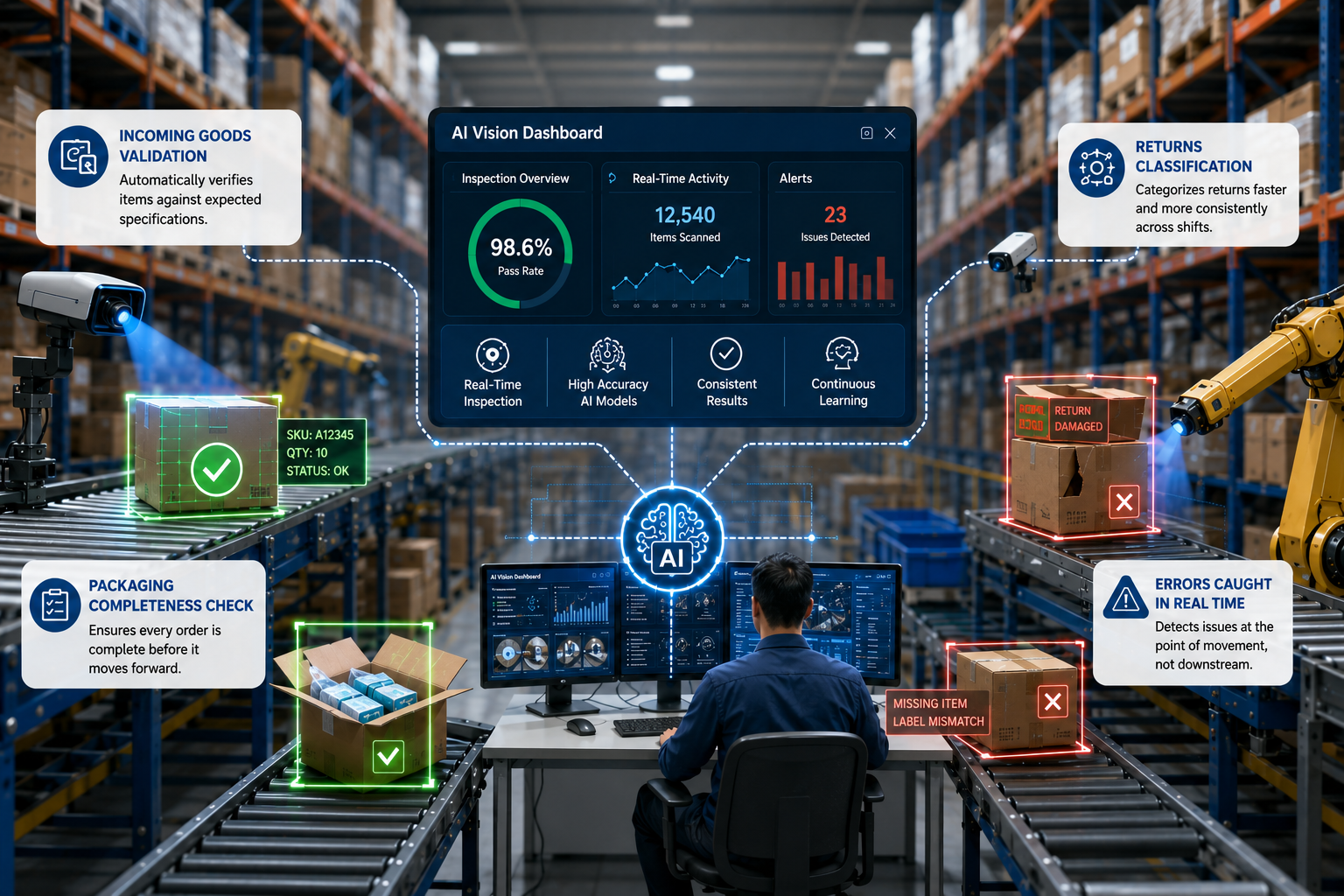
Manual scanning and inspection have long been a hidden cost driver in warehouses. AI-Powered Computer Vision is changing that by verifying goods while they move, not after operations stop.
Where Computer Vision Adds Value
- Incoming goods are validated automatically against expected specifications
- Returns are classified faster and more consistently across shifts
- Packaging completeness is checked without manual intervention
- Errors are caught at the point of movement rather than discovered downstream
The result is fewer errors, faster throughput, and better data quality feeding every other AI system in the warehouse. But this only works with rigorous Software Testing during implementation, since a vision model making incorrect calls at scale can be more disruptive than the manual process it replaces. Quality control becomes continuous rather than a separate checkpoint bolted onto the process.
How Predictive Forecasting and Digital Twins Are Shaping AI-Powered Logistics Solutions
Volatility is the new normal. Peak seasons, supplier disruptions, and shifting demand patterns mean many warehouses still react too late. Forecasting is becoming operational rather than purely analytical.
From Historical Data to Live Simulation
Modern AI models combine internal data, such as orders, inventory levels, and process history, with external signals like weather, traffic, and market shifts. This is where Python Development plays a direct role, since most forecasting pipelines, machine learning models, and digital twin simulations are built and maintained in Python for its flexibility with data science libraries.
Digital twins take this further by allowing teams to simulate scenarios before they happen:
- What happens if demand spikes next week
- How a layout change impacts overall throughput
- What happens operationally if a key supplier fails
This shifts the operating question from "what happened" to "what will happen, and what should we do right now."
How AI Development Is Making Sustainability a Measurable Outcome in Logistics
Sustainability has moved from a side conversation to a compliance requirement. Regulations and reporting standards increasingly demand precise, transparent data across the entire supply chain, and AI plays a central role in meeting them.
Where AI Supports Sustainable Logistics
- Tracking emissions across upstream and downstream processes
- Optimizing energy usage in real time across facilities
- Improving packaging and transport efficiency
- Automating complex reporting requirements, including Scope 3 emissions
Sustainability and efficiency are no longer trade-offs when they are built into the same system. This is largely a Data Analytics challenge, since sustainability reporting depends on consistent data pipelines rather than isolated spreadsheets pulled together at quarter end.
Why Connected Systems Matter More Than Standalone
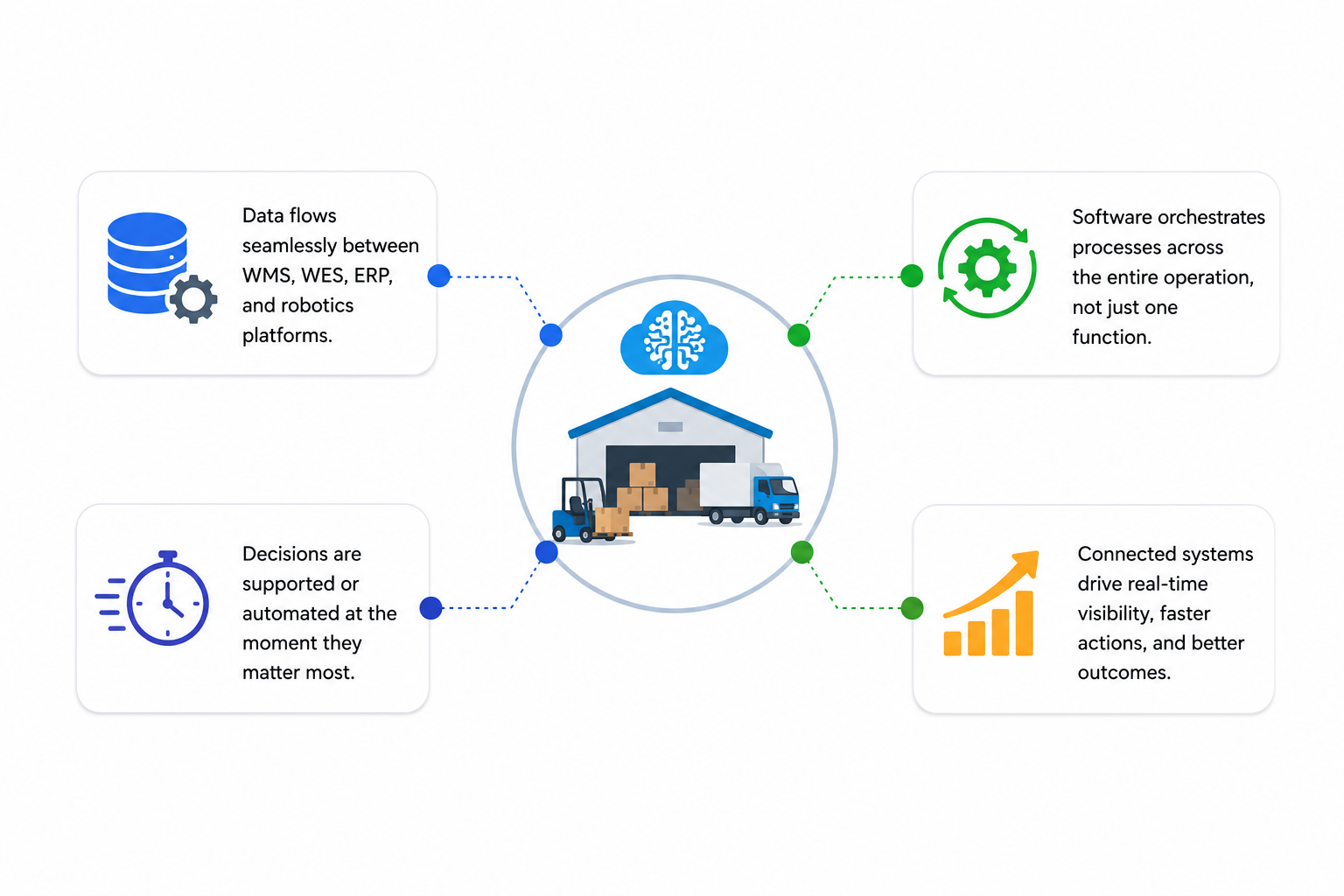
None of the trends above work in isolation. A vision system without connected forecasting data has no early warning value. A decision engine without orchestrated robotics cannot act on its own recommendations. The real value of AI in logistics emerges only when systems are connected end to end.
This means:
- Data flows seamlessly between WMS, WES, ERP, and robotics platforms
- Software orchestrates processes across the entire operation, not just one function
- Decisions are supported or automated at the moment they matter most
A practical way to evaluate where to start is to ask three questions: Where do decisions still rely on gut feeling instead of data? Which processes would benefit most from real-time prioritization? Where are inefficiencies caused by disconnected systems rather than a lack of technology? Starting there usually reveals the highest-impact opportunities.

Ready to Build Your AI-Powered Logistics Solution?
Every warehouse has different processes, data, and goals, so a generic AI tool will only get you so far. TechWize builds custom AI Logistics Software Development around your actual operations, from decision engines to robotics orchestration and beyond. Let's map out where AI can create the biggest impact for your warehouse.
Build Your AI Logistics SolutionTechWize: Your Trusted Company for Custom AI-Powered Logistics Solutions
Every warehouse starts from a different point, with different systems, data maturity, and operational goals. That is why the strongest logistics software is never off-the-shelf.
TechWize builds AI-Powered Logistics Solutions designed around a client's actual processes and data, not a generic template. Our team combines AI Logistics Software Development with full-stack Web and App Development. Hence,o warehouse dashboards, mobile operator tools, and backend orchestration systems work as one connected platform rather than disconnected pieces.
Whether the need is a decision engine layered on top of an existing WMS, a computer vision integration for quality control, or a full forecasting and digital twin build, TechWize's AI Development team works from the ground up to fit the systems already in place. The goal is not to sell a product; it is to build the system a warehouse actually needs.
Read Similar Blog
What Conversational AI for E-commerce Can Do for Your Logistics Operations
Explore More AI Insights ⬩➤Conclusion: Building Your 2026 AI in Logistics Roadmap with the Right Software Development Company
AI in logistics is no longer an experiment; it is infrastructure. The warehouses pulling ahead in 2026 are not necessarily the ones with the most AI tools; they are the ones with the most connected, well-orchestrated systems built around their actual operations.
The right approach is not to "do everything AI" at once. It is to identify the highest-impact gaps, whether in decision-making, robotics coordination, quality control, forecasting, or sustainability reporting, and build from there with a software development company that understands both the technology and the floor it runs on.
If your team is ready to move from scattered AI pilots to a connected, custom-built logistics platform, TechWize is ready to help map that roadmap and build it.