
 501, Fifth Avenue, Suite 805 New York, NY 10017
 info@techwize.com
 +1 (949) 887-0154
 TechWize
If you've spent any time comparing CRMs, you already know the sales pages all sound the same. Everyone claims to be "powerful," "flexible," and "built for growth." So let's skip that part.
This comparison looks at Dynamics 365 Customer Engagement vs. Odoo the way a business owner actually needs to see it: cost, setup time, day-to-day usability, and what happens six months after go-live, when your team is actually using it. Both platforms are genuinely good. But they're built for different situations, and picking the wrong one is an expensive mistake to walk back from.
Dynamics 365 Customer Engagement vs Odoo: Quick Comparison Snapshot
Here's the short version before we get into the details.
| Factor | Dynamics 365 Customer Engagement | Odoo |
|---|---|---|
|
Best for |
Mid-size to enterprise, Microsoft-heavy orgs |
SMBs to mid-market, budget-conscious teams |
|
Pricing model |
Per-app, per-user (module-based) |
Flat per-user, all apps included |
|
Setup time |
3 to 9 months typically |
6 weeks to 4 months typically |
|
Customization |
Power Platform, low-code, governed |
Open-source Python, deep code access |
|
Ecosystem fit |
Native with Outlook, Teams, Power BI |
API and connector-based |
|
Recognition |
Gartner Leader, CRM Customer Engagement Center 2025 (source: Microsoft Dynamics 365 Blog) |
170,000+ enterprise customers globally (source: Glorium Tech) |
The table's useful, but it doesn't tell the whole story. Keep reading.
What Makes Dynamics 365 Customer Engagement and Odoo Different?
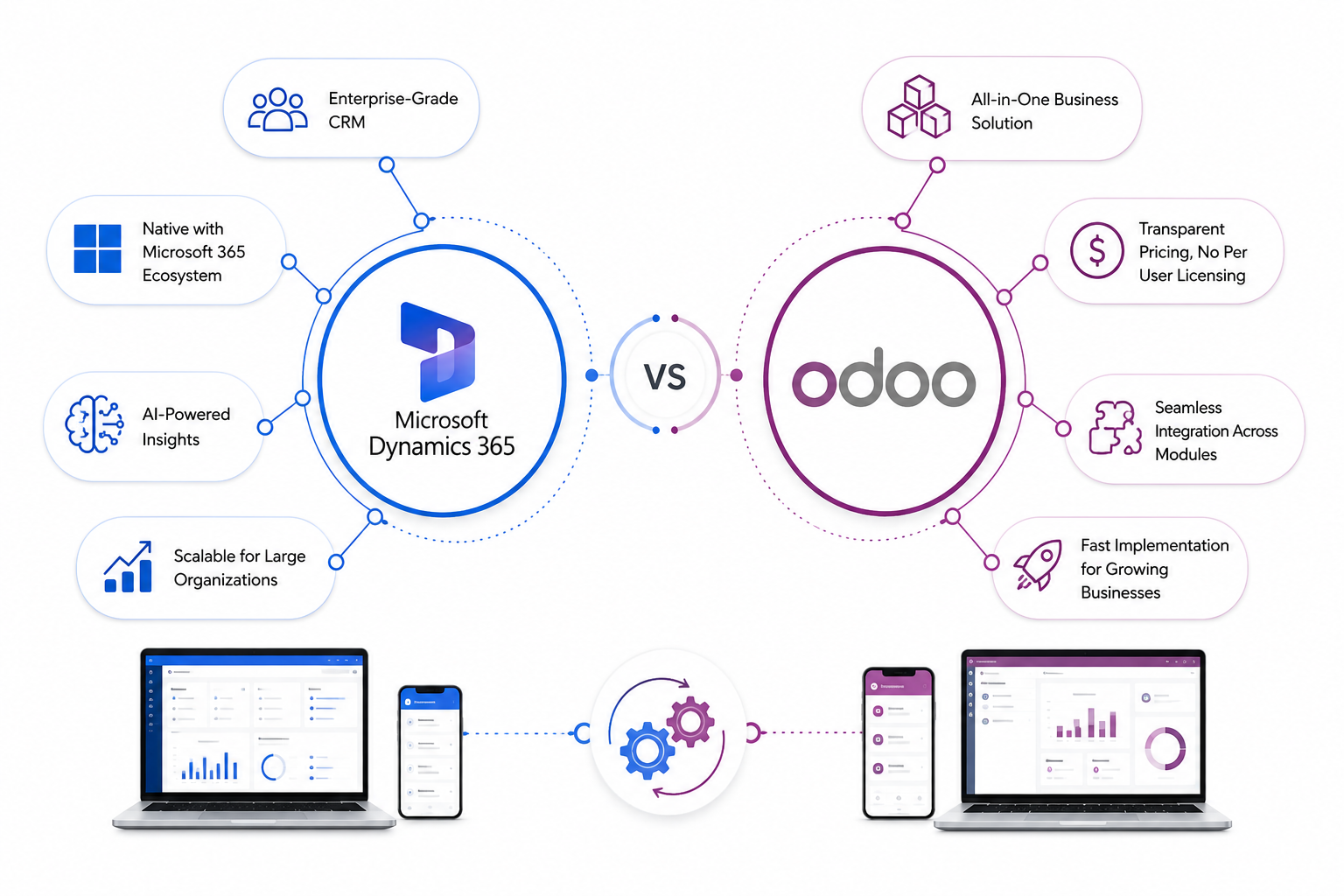
Dynamics 365 Customer Engagement (which today mostly refers to Dynamics 365 Sales, Customer Service, and the underlying Power Platform) is Microsoft's answer to enterprise-grade CRM. It's built to sit inside a business that already runs on Outlook, Teams, and Excel. Everything talks to everything, and that's kind of the whole point.
Odoo, on the other hand, was never trying to be "the Microsoft one." It started as an open-source ERP and later added a CRM module that plugs directly into inventory, accounting, and website tools, without requiring separate licenses for each. Gartner named Microsoft a Leader in its 2025 Magic Quadrant for CRM Customer Engagement Center, largely on the strength of its AI strategy and unified Power Platform (source: Microsoft Dynamics 365 Blog, November 2025). Meanwhile, Odoo has quietly become one of the fastest-growing ERP platforms on the planet, now serving more than 170,000 enterprise customers and adding roughly 13,000 new clients a month (source: Glorium Tech, 2026).
Here's the thing nobody really says out loud: Dynamics 365 wins on depth and AI polish, Odoo wins on speed and honesty about pricing. Neither one is "better" in the abstract. It depends entirely on what your team already has and what they're allergic to.
If your sales and support teams already use Dynamics 365 CRM Solutions alongside Outlook and Teams daily, switching away from that ecosystem creates friction that's hard to justify. But if you're a growing company that doesn't want to pay per app, Odoo starts to look a lot more sensible.
Dynamics 365 Customer Engagement vs Odoo: Which Offers Better Value?
Value isn't just the sticker price. But let's start there anyway, because it's usually the first question a CFO asks.
Dynamics 365 licensing is per-app. Business Central Essentials runs about $80 per user per month, and Premium sits at $110 (source: Microsoft, 2025). Add Sales or Customer Service modules and the bill climbs fast, especially once you're outfitting a team of 50 or more.
Odoo flips that model. You pay one flat rate and get access to every app in the suite, from CRM to inventory to accounting. Standard plans run in the low thirties per user, and the free "One App" tier exists specifically so smaller teams can try before committing.
The average ERP implementation across the industry costs around $450,000 when you factor in licensing, migration, training, and customization (source: Panorama Consulting, 2025). That number swings wildly depending on which platform you're on and how much custom work you need. And here's something worth noting: over 25 percent of ERP implementations exceed their original budget, usually due to late scope changes rather than the software itself (source: Panorama Consulting, 2025). That's a project management problem as much as a platform problem, honestly.
For deeper cost planning, most businesses lean on internal Business Intelligence and forecasting before locking in a platform. It's the boring step everyone skips and later regrets.
How Dynamics 365 Customer Engagement Compares with Odoo in Customization and Flexibility
This is where the two platforms genuinely feel like different species.
Dynamics 365 relies on the Power Platform, so most customization occurs through Power Apps, Power Automate, and low-code tools rather than raw code. It's governed and sandboxed, and updates rarely break things because Microsoft tightly controls the whole pipeline. Good for IT teams that want guardrails. Less good if you need something the platform genuinely wasn't designed to do.
Odoo goes the opposite direction entirely. It's open-source Python underneath, so a developer can open the code and change core behavior directly. Want a workflow that doesn't exist anywhere in the standard product? Build it. That flexibility is real, but it comes with a catch: custom modules require ongoing maintenance, and upgrades to heavily customized instances take more planning than with plug-and-play SaaS tools.
I've seen teams get genuinely excited about Odoo's flexibility in the first month, then get a little overwhelmed by month six when they realize custom code needs a dedicated owner. That's not a knock on the platform. It's just a resourcing reality that doesn't show up in the demo.
Dynamics 365 Customer Engagement vs Odoo: Implementation Timelines and Complexity
Timelines are where the platforms diverge the most in practice, not just on paper.
A mid-market Dynamics 365 rollout typically runs three to nine months, especially once you factor in Microsoft Dynamics 365 Integrations with existing Outlook, Teams, and Azure Active Directory setups. That's not a criticism of the platform. It's structured that way because enterprise governance and security reviews take time, and rushing that part usually costs more later.
Odoo Implementation Services tend to move faster. Basic deployments often go live in six to twelve weeks, and even mid-scope projects with custom integrations usually wrap inside three to six months. Odoo's phased approach means you can launch Sales and CRM first, then bolt on the Inventory or Field Service modules later without having to redo the whole architecture.
Speaking of which, if your business has technicians or on-site teams, both platforms offer solid options. Dynamics 365 Field Service Solutions brings scheduling, mobile work orders, and IoT-based predictive maintenance into the same system as your sales pipeline. Odoo's equivalent module is lighter but genuinely capable for small to mid-size field teams that don't need the full enterprise toolkit yet.

Need Help Choosing Between Dynamics 365 Customer Engagement and Odoo?
Every business has unique CRM requirements. TechWize helps you evaluate Dynamics 365 Customer Engagement and Odoo based on your business goals, workflows, budget, and future growth plans, ensuring you invest in the right platform.
Talk to Our CRM ExpertsWhich CRM Delivers More Value for Your Business?
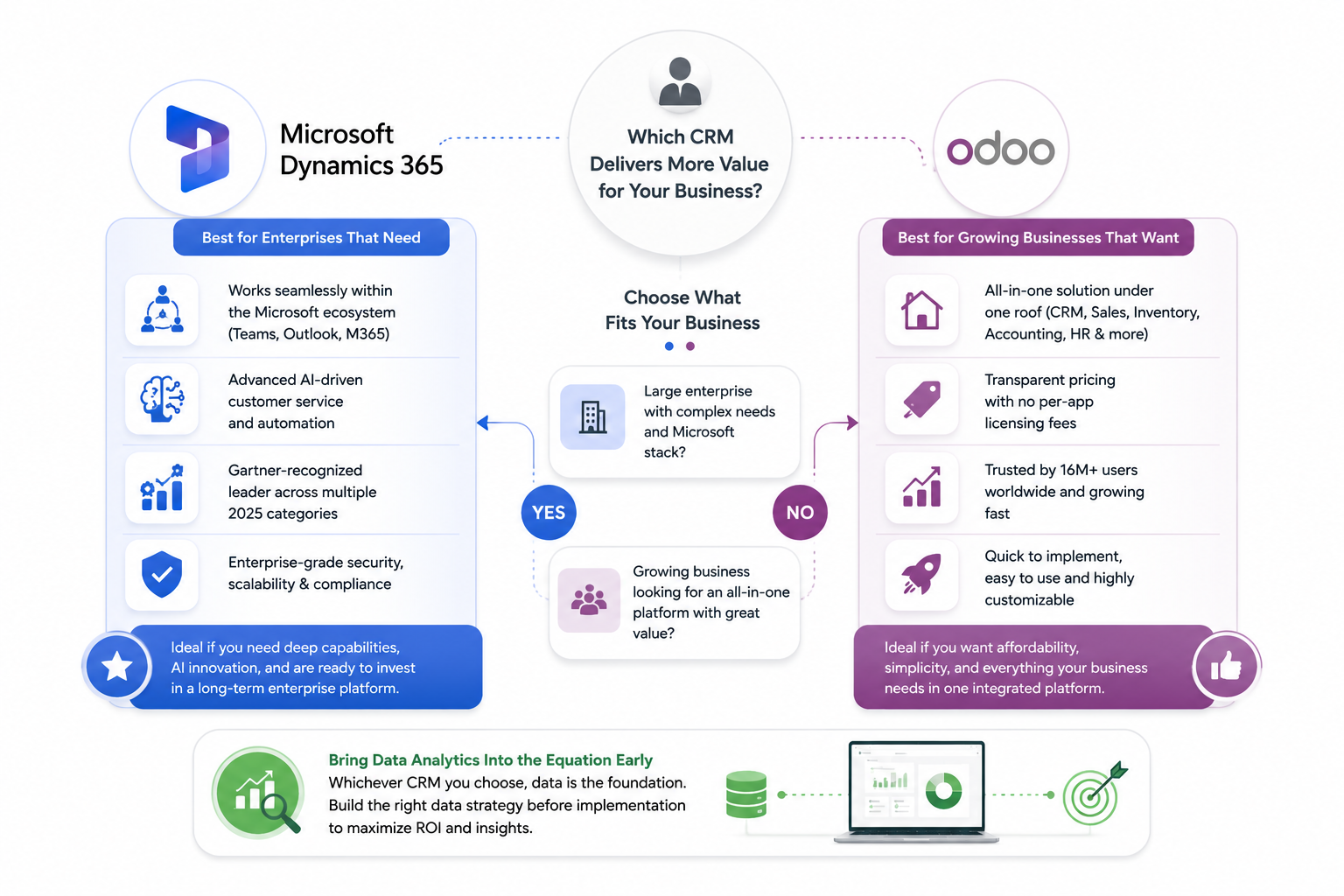
So, bottom line. If your company already lives inside the Microsoft ecosystem and needs deep AI-driven customer service tools, Dynamics 365 Customer Engagement earns its price tag. It's now a Gartner-recognized platform across multiple categories, including three separate 2025 Magic Quadrant Leader placements for Cloud ERP (source: Microsoft Dynamics 365 Blog, December 2025), and that kind of validation matters when you're making a five-year bet.
If you're a growing business that wants everything under one roof without a per-app pricing headache, Odoo is genuinely the smarter starting point. And with more than 16 million users worldwide now and revenue climbing toward the €800 million mark in 2026 (source: AppVerticals, 2026), it's not the scrappy underdog it used to be. It's a legitimate enterprise-grade option that's still affordable.
Pull in Data Analytics early in either evaluation. Whichever platform you pick, the CRM is only as good as the data feeding it, and that groundwork should happen before implementation, not after.
Why TechWize Is Your Trusted Dynamics 365 Customer Engagement and Odoo Implementation Company
Full disclosure, this is the part where we mention what we do, so feel free to skip ahead if you're just here for the comparison.
We've sat on both sides of this decision with clients more times than we can count, which is honestly why this blog doesn't try to crown a winner. TechWize works across Dynamics 365 Customer Engagement and Odoo Implementation Services, as well as Microsoft Dynamics 365 Integrations and Dynamics 365 Field Service Solutions, for teams that need built-in scheduling and mobile workforce tools from day one. Because we're not locked into selling just one platform, the recommendation you get is based on your actual workflow, not on which license generates more commission.
Read Similar Blog
Microsoft Foundry AI Agents: Redefining Dynamics 365 Execution in 2026
Explore More Dynamics 365 Insights ⬩➤Conclusion: Choose the Right CRM for Your Business
There's no universal right answer here, and honestly, anyone who tells you there is hasn't implemented either platform for a real client. Dynamics 365 Customer Engagement rewards businesses that are already deep in Microsoft's world and need enterprise-grade governance. Odoo rewards businesses that want speed, transparency in pricing, and the freedom to shape the system around themselves rather than the other way around.
The best move is probably to sit down with your actual workflows, not the feature list, and ask which platform disappears into the background fastest. That's usually the real test of good software anyway.