
 501, Fifth Avenue, Suite 805 New York, NY 10017
 info@techwize.com
 +1 (949) 887-0154
 TechWize
Every growing business eventually hits the same wall - the tools that worked fine in the early days stop keeping up. Spreadsheets turn into bottlenecks, off-the-shelf software cannot handle unique workflows, and teams end up patching problems instead of solving them. This is where Enterprise Software Development Services step in.
But building enterprise-grade software is not simple. It involves shifting requirements, tightening security expectations, growing data volumes, and the pressure to move fast without breaking things. Even well-funded, well-staffed teams run into roadblocks that slow down delivery and inflate costs.
This blog breaks down the six biggest roadblocks businesses face in enterprise software development today, along with the modern solutions that are actually helping teams move past them - and where custom enterprise software development fits into the bigger picture.
Signs Your Business Needs Custom Enterprise Software Development
Not every business needs a custom-built system right away. But certain signs tend to show up consistently when off-the-shelf tools stop being enough:
- Your team is using three or more disconnected tools to manage one process
- Manual work-arounds have become a regular part of daily operations
- Existing software cannot scale with your user base or data volume
- Security or compliance requirements are outgrowing generic platforms
- Customer or employee experience is suffering because of clunky, outdated systems
If two or more of these sound familiar, it is usually a sign that a custom-built approach, tailored to how your business actually operates, is worth exploring.
The 6 Biggest Roadblocks in Enterprise Software Development
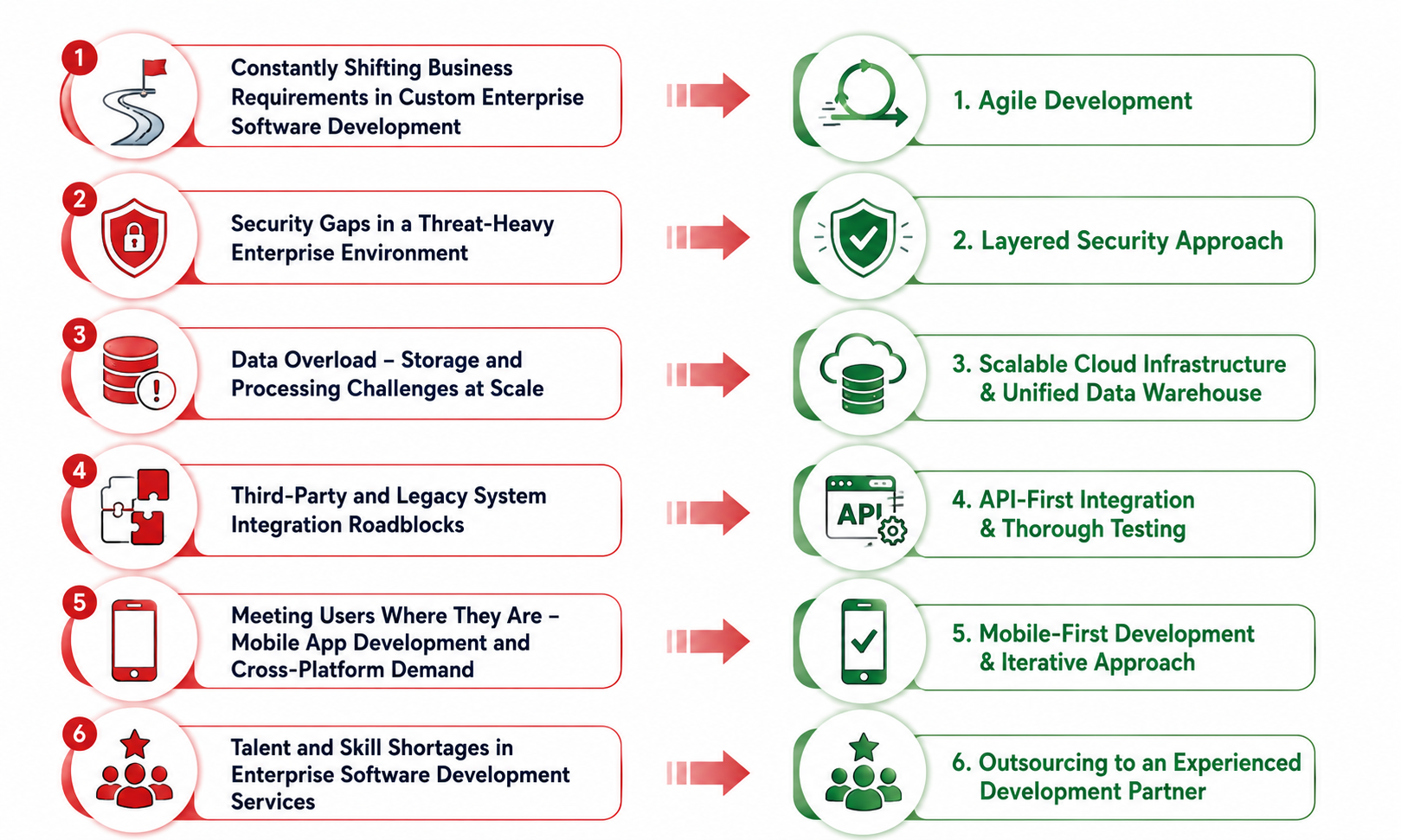
1. Constantly Shifting Business Requirements in Custom Enterprise Software Development
The Roadblock: Business needs rarely stay still. A project scoped in January can look completely different by June. Agile development allows requirements to adapt seamlessly, giving teams the confidence to handle change without losing momentum.
The Solution: Agile development is built for exactly this problem. Instead of locking in a rigid plan upfront, agile sprints allow requirements to evolve without derailing the entire project. Partnering with a team experienced in enterprise software development services means requirement changes get absorbed into the workflow, not treated as emergencies.
2. Security Gaps in a Threat-Heavy Enterprise Environment
The Roadblock: Enterprise applications hold sensitive data - financial records, customer info, and internal operations. Implementing layered security strategies ensures your organization can confidently protect data, reducing anxiety over cyber threats.
The Solution: A layered security approach works best:
- Regular patching and updates to close known vulnerabilities
- A Secure Development Lifecycle (SDLC) that builds security checks into every phase, not just at the end
- Routine security audits to catch weak points before attackers do
- A zero-trust model, where no user or device is trusted automatically, reducing the blast radius of any breach
3. Data Overload - Storage and Processing Challenges at Scale
The Roadblock: Enterprise systems generate vast data volumes. Scalable cloud infrastructure and a unified data warehouse empower your business to grow without data bottlenecks, inspiring confidence in future expansion.
The Solution: Cloud-based storage platforms give businesses the flexibility to scale storage up or down without overinvesting in physical infrastructure. Pairing this with a centralized enterprise data warehouse creates a single source of truth, making reporting and analysis far more reliable.
4. Third-Party and Legacy System Integration Roadblocks
The Roadblock: Most enterprises are not building from scratch - they are working around legacy systems and integrating multiple third-party tools. Outdated architecture makes this integration slow and fragile, often creating more problems than it solves.
The Solution: An API-first approach makes integration far more manageable, allowing systems to communicate cleanly without constant custom fixes. Working with a partner that understands both legacy environments and modern integration practices, combined with thorough testing before go-live, prevents small integration issues from becoming major outages later.
5. Meeting Users Where They Are - Mobile App Development and Cross-Platform Demand
The Roadblock: Employees and customers increasingly expect enterprise tools to work as smoothly on mobile as they do on desktop. Businesses that treat mobile as an afterthought end up with clunky, underused applications.
The Solution: Building with mobile app development in mind from day one - not bolting it on later - leads to a far better experience. This means designing user-friendly interfaces, optimizing performance for mobile networks, and testing across devices before launch. An iterative approach also allows the app to keep evolving as usage patterns change.
6. Talent and Skill Shortages in Enterprise Software Development Services
The Roadblock: Hiring in-house specialists for niche tech stacks takes time and money, and the demand for skilled developers often outpaces supply. This shortage can stall enterprise projects before they even get off the ground.
The Solution: Outsourcing to a proven enterprise software development company gives businesses immediate access to experienced teams without the long hiring cycle. This hybrid approach - core business logic managed in-house, specialized development outsourced - is becoming one of the most practical ways to close the talent gap.
Emerging Technologies Reshaping Enterprise Software Development
A few technologies are actively changing how enterprise software gets built and maintained:
Artificial Intelligence (AI): AI is making enterprise applications smarter and more automated - from intelligent chatbots handling customer support to machine learning models powering predictive analytics for business decisions.
Blockchain: Blockchain adds a layer of transparency and security that is especially valuable in supply chain management, where tracking goods from origin to delivery needs to be tamper-proof and trustworthy.
Cloud Computing: Cloud infrastructure continues to be one of the biggest shifts in how enterprises operate, giving businesses the flexibility to scale resources without the overhead of maintaining physical servers.
Low-Code and No-Code Platforms: These platforms are speeding up development cycles by allowing teams to build and test features faster, reducing dependency on large development teams for every small change.
Enterprise Software Development Roadblocks by Industry
Different industries tend to feel these roadblocks in different ways:
- Healthcare: Compliance and data privacy dominate solutions centered on strict access controls and secure web and app development practices built for regulated environments.
- Finance: Security and real-time data processing are the biggest pain points; cloud-based infrastructure and zero-trust models help manage both.
- Retail: Integration with multiple sales channels and inventory systems is the main challenge. API-first architecture keeps everything connected.
- Manufacturing: Legacy systems and supply chain visibility create friction. Python development is often used to build the automation and data pipelines that modernize these operations.
What's Right for You: In-House Team vs Outsourced Enterprise Software Development Company
There is no universally right answer here - it depends on the project timeline, budget, and how specialized the required skill set is. Many businesses now use a hybrid model, keeping strategic decisions in-house while outsourcing execution to a dedicated development partner.
Measuring Success - KPIs That Matter in Enterprise Software Development
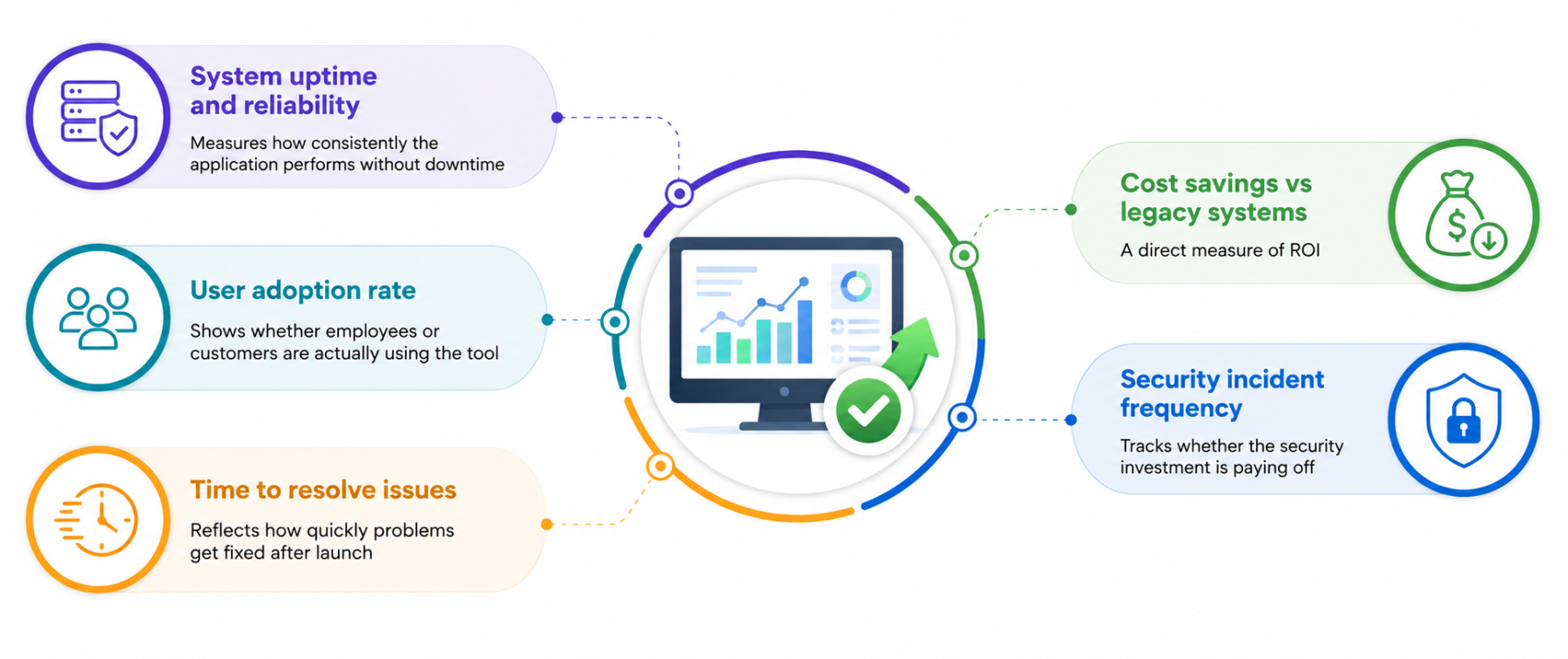
Once an enterprise application is live, tracking the right metrics matters as much as building it correctly. Key performance indicators worth monitoring include:
- System uptime and reliability: Measures how consistently the application performs without downtime
- User adoption rate: Shows whether employees or customers are actually using the tool
- Time to resolve issues: Reflects how quickly problems get fixed after launch
- Cost savings versus legacy systems: A direct measure of ROI
- Security incident frequency: Tracks whether the security investment is paying off
Tracking these consistently helps businesses know whether their enterprise software investment is actually delivering value, not just functioning.

Ready to Solve Your Enterprise Software Roadblocks?
Every roadblock covered in this blog has a proven fix, and TechWize helps you put it into action. From custom builds to full-scale enterprise platforms, our team designs software that scales as your business grows. Let's turn your biggest challenges into your next growth milestone.
Talk to Our ExpertsTechWize - Enterprise Software Development Services That Solve Real Problems
TechWize builds enterprise software with these exact roadblocks in mind - not as an afterthought, but as the starting point of every project. From custom enterprise software development to web and app development, our teams focus on solving the operational bottlenecks that slow businesses down.
What sets TechWize apart as an enterprise software development company is a combination of technical depth and practical delivery - agile teams that adapt to shifting requirements, security built into every stage of development, and integration expertise that connects legacy systems with modern platforms without constant firefighting.
Businesses working with TechWize get more than code - they get a team that understands how to translate business goals into software that actually scales, stays secure, and keeps up with changing demands.
Read Similar Blog

How to Build Fleet Management Software in Australia: Features, Cost & Trends
Explore More Insights ⬩➤Conclusion: Turning Enterprise Software Development Roadblocks into Growth Opportunities
Every roadblock covered here - shifting requirements, security gaps, data overload, integration friction, mobile demand, and talent shortages - is solvable with the right approach and the right team. The businesses that treat these roadblocks as growth opportunities, rather than permanent obstacles, are the ones building software that lasts.
If your business is ready to move past these roadblocks, TechWize's Enterprise Software Development Services are built to help you get there - with solutions designed around how your business actually works, not a generic template.