
 501, Fifth Avenue, Suite 805 New York, NY 10017
 info@techwize.com
 +1 (949) 887-0154
 TechWize
Delivering exceptional patient care in Australia now depends as much on digital infrastructure as it does on clinical expertise. It is increasingly defined by the digital infrastructure that sits behind every patient record, every telehealth session, every clinical decision support tool, and every hospital management workflow. As digital transformation accelerates across Australian health systems, the demand for reliable, compliant, and future-ready Healthcare Software Development Solutions has never been more urgent.
Choosing the right software development company in Australia is not simply a technology decision. It is a patient safety decision. A poorly built system can cause medication errors, data breaches, regulatory penalties, and disruptions to care delivery. On the other hand, a well-engineered healthcare platform can dramatically improve clinical outcomes, streamline operational efficiency, and elevate the overall standard of care delivery.
This guide is written for healthcare executives, digital health product leads, hospital administrators, and startup founders who are actively evaluating development partners in 2026. We cover the top eight companies, the key criteria for selection, the essential features your software must include, and a realistic view of how pricing works in the Australian market.
Why Australia Is a High-Stakes Healthcare Technology Market in 2026
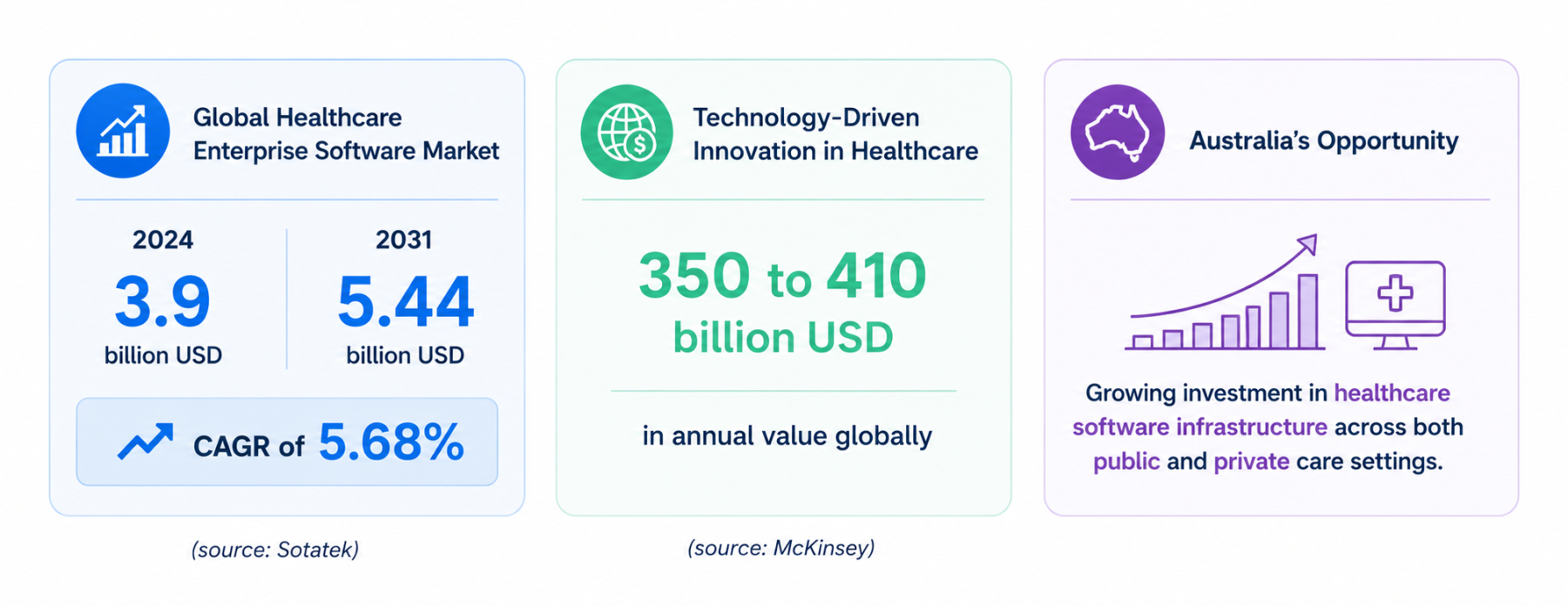
The global healthcare enterprise software market is on a strong upward trajectory, projected to grow from 3.9 billion USD in 2024 to 5.44 billion USD by 2031 at a compound annual growth rate of 5.68%(source: Sotatek). Technology-driven innovation in healthcare is estimated to generate 350 to 410 billion USD in annual value globally (source: McKinsey). For Australia, a country with a well-funded, regulation-driven health system and a rapidly maturing digital health sector, these numbers translate directly into growing investment in healthcare software infrastructure across both public and private care settings.
Australia operates one of the most complex and compliance-driven healthcare environments in the world. The My Health Record system, the Therapeutic Goods Administration (TGA) digital health frameworks, state-specific health data regulations, and the broader requirements of the Privacy Act all create a demanding environment for software development.
Beyond compliance, the market is being shaped by the rise of telehealth adoption, the integration of wearable health devices, the push toward interoperability between private and public health systems, and the growing role of artificial intelligence in diagnostics and care planning.
Any Software Development Company operating in this space must deeply understand not just how to code, but how healthcare actually works, how clinical workflows are structured, and what makes a system trustworthy enough to deploy in a live care environment.
Comparison Table of Healthcare Software Development Firms
| Company | Founded | Specialization | Key Services |
|---|---|---|---|
| TechWize | 2000 | Enterprise Healthcare Software, ERP, AI-Driven Healthcare Solutions | Custom Healthcare Software, Mobile App Development, EHR, AI Integration, Enterprise Cloud Consulting, Data Analytics |
| AppInventiv | 2015 | Healthcare Mobile Apps, Digital Health Products | Mobile App Development, AI Healthcare Solutions, UI/UX Design |
| TatvaSoft | 2001 | Custom Software, Healthcare Portals | Custom App Development, System Integration, QA Testing |
| VrinSoft | 2009 | Web and Mobile Healthcare Applications | App Development, Software Consulting, Cloud Services |
| Q3 Technologies | 1996 | Healthcare Software, Telehealth Solutions | Custom Development, API Integration, Mobile Health |
| FortuneSoft | 2009 | Healthcare IT, Enterprise Applications | Custom Development, System Integration, Cloud Migration |
| Webhouse | 2023 | Digital Solutions for Australian Businesses | Web Development, Digital Strategy, CMS Solutions |
| Banao Tech | 2013 | Product Engineering, Health Tech Startups | Full-Stack Development, MVP Builds, Product Design |
Top 8 Healthcare Software Development Companies in Australia for 2026
1. TechWize
Founded in 2000, TechWize is an Australia-based IT consulting firm with over two decades of experience in enterprise healthcare software. Their services span custom health platforms, ERP and CRM solutions, AI integration, cloud architecture, and data analytics. They serve both large health networks and growing digital health startups across Australia.
In healthcare, TechWize covers the full technology spectrum – from custom health platform development and ERP/CRM implementation to AI-powered solutions, cloud infrastructure, data analytics, and mobile application development. Their healthcare-specific capabilities include Salesforce Health Cloud implementation, AI voice agents for appointment booking and record retrieval, iPaaS integrations for connecting disparate health systems, and Microsoft Power Apps for rapid internal workflow automation.
Key Facts About TechWize
| 100+ Senior IT professionals with 8+ years of average experience |
500+ Projects and client engagements delivered |
| ISO 27001 Certified |
HIPAA Compliant |
| AICPA SOC Certified |
25+ Years of enterprise delivery experience |
What makes TechWize a strong fit for healthcare is not just service breadth. It is their structured engagement model, long-term client relationships, and deep understanding of how regulated industries operate. They work as a sustained technology partner aligned to each client's growth trajectory – not a one-time delivery vendor.
Best Fit: Healthcare organizations seeking a reliable, long-term technology partner with proven enterprise delivery capabilities and strong healthcare domain knowledge.
2. AppInventiv
AppInventiv is a global technology firm with an Australian healthcare focus. They build compliance-driven digital health products, including patient engagement platforms, telehealth applications, and AI-integrated clinical tools. Their approach combines product design with engineering to deliver solutions across both provider and patient-facing use cases.
Best Fit: Organizations looking for design-led, AI-powered healthcare product development.
3. TatvaSoft
TatvaSoft is a custom software development company in Australia. They build tailored web and mobile applications, patient portals, and system integrations for healthcare clients. Their service range covers consulting, architecture, development, quality assurance, and ongoing maintenance across organizations of varying sizes.
Best Fit: Healthcare businesses needing structured, end-to-end custom software delivery with QA focus.
4. VrinSoft
VrinSoft delivers web and mobile development solutions to healthcare and related industries in Australia. They focus on practical, scalable applications built around specific clinical and operational workflow requirements. Their team also provides consulting services for organizations in the planning stages of their digital transformation.
Best Fit: Mid-size healthcare providers needing scalable web and mobile application development.
5. Q3 Technologies
Q3 Technologies offers custom healthcare software, telehealth solutions, and mobile health applications. Their development practice covers clinical management systems, patient engagement tools, and health data processing, all built with security and regulatory compliance as core considerations throughout the project lifecycle.
Best Fit: Healthcare companies requiring secure, regulation-aware custom software and telehealth solutions.
6. FortuneSoft
FortuneSoft is an IT services company with a dedicated healthcare software practice. They specialize in enterprise application development, system integration, and cloud migration. Their delivery model suits organizations that need stable, long-running systems built for operational reliability rather than rapid short-cycle experimentation.
Best Fit: Larger healthcare organizations requiring stable enterprise software and cloud migration expertise.
7. Webhouse
Webhouse is an Australian digital agency serving healthcare, among other sectors. Their core services include web development, digital strategy, and CMS-based platform delivery. They are well-suited for healthcare providers that need strong web-facing platforms, patient communication portals, or improvements to their broader digital presence.
Best Fit: Healthcare providers focused on web platforms, digital presence, and patient-facing communication tools.
8. Banao Tech
Banao Tech is a product engineering company serving startups and growth-stage businesses in health tech and beyond. They specialize in MVP development, full-stack engineering, and product design. Their lean delivery model is built for organizations that need to move from concept to a working product without unnecessary delays.
Best Fit: Digital health startups needing fast, focused MVP development and product engineering support.
Key Factors to Consider While Choosing a Healthcare Software Development Company in Australia
Selecting a software development company in healthcare requires more scrutiny than in most other industries. Before signing any contract, you should evaluate the following areas carefully.
Regulatory Knowledge: Your partner must understand Australian healthcare regulations, including TGA requirements, My Health Record interoperability standards, and state privacy laws. A team without this knowledge will build a product that fails a compliance review.
Domain Experience: Healthcare workflows are highly specific. A developer who has only built e-commerce platforms will struggle to understand clinical data models, HL7 FHIR standards, and the nuances of medication management or care coordination modules.
Security Architecture: Patient data is among the most sensitive in existence. Your partner must demonstrate a strong track record in building secure systems with proper encryption, role-based access controls, audit logging, and vulnerability management.
Scalability Planning: Healthcare systems often begin with one department or one clinic and grow into network-wide platforms. Make sure your development partner builds with growth in mind from the start.
Post-Launch Support: A healthcare system going down mid-shift is a serious event. Choose a partner with a clear support model, rigorous Software Testing practices, and defined service level agreements for production environments.
Must-Have Features in Healthcare Software in 2026
As healthcare technology matures, there is a baseline set of features that any modern healthcare software product must include to be considered ready for deployment.
- Electronic Health Records (EHR) – Integration or Native: Whether you build your own or integrate with an existing system, structured patient records are non-negotiable.
- Telehealth and Remote Consultation Modules: Video, messaging, and asynchronous communication tools for patients and clinicians are now standard expectations.
- Interoperability via HL7 FHIR: The ability to exchange data with other systems using modern health data standards is essential for any platform operating in the Australian health ecosystem.
- Role-Based Access Controls: Different users, from nurses to specialists to administrators, need different access levels. This must be built into the system architecture.
- Clinical Decision Support: AI-driven alerts, drug interaction checks, and evidence-based recommendations are becoming standard features in advanced platforms.
- Patient Engagement Tools: Appointment booking, medication reminders, health tracking dashboards, and secure messaging help drive adherence and satisfaction.
- Audit Trails and Compliance Logging: Every action in a healthcare system should be logged for compliance and accountability purposes.
- Data Analytics Dashboards: Operational reporting, population health insights, and clinical performance metrics give administrators and clinicians the visibility they need to make good decisions.
Technology Stack - Hire a Dedicated Healthcare Software Development Team in Australia
Building a complete healthcare software product requires a team of specialists, not just generalist developers. Here is a breakdown of the roles your team will typically need.
Hire Frontend Developers
Frontend developers build the interfaces that clinicians, patients, and administrators interact with every day. In healthcare, these interfaces must be intuitive under pressure, accessible to a wide range of users, and compliant with web accessibility standards. Technologies commonly used include React, Angular, and Vue.js.
Hire Backend Developers
Backend developers manage the logic, data storage, and integrations that power your healthcare application. They work with technologies such as Node.js, Python, Java, and .NET, and must be skilled in building HIPAA-aware and privacy-first architectures. Their work is where clinical data rules and business logic live.
Hire Mobile App Developers
With clinicians using tablets and patients managing their health through smartphones, mobile app development is a core requirement for most healthcare platforms. iOS and Android developers with healthcare experience understand the specific design and data security constraints of mobile health applications.
Hire Full-Stack Developers
Full-stack developers can span both frontend and backend work, which is valuable for smaller teams or MVP-stage projects. They are useful for rapid iteration and for building proof-of-concept systems before scaling up.
Hire Cloud and DevOps Engineers
Healthcare software must be available around the clock, updated without downtime, and scaled to meet demand. Cloud and DevOps engineers manage infrastructure on platforms like AWS, Azure, and Google Cloud, and implement CI/CD pipelines that allow your team to release updates safely and frequently.
Hire Healthcare Integration Specialists
These are specialists who understand health data standards such as HL7, FHIR, DICOM, and ICD codes. They build the connections between your software and external systems like hospital management platforms, pathology labs, imaging systems, and government health data repositories.

Ready to Build Your Healthcare Software?
TechWize has been delivering enterprise-grade healthcare software solutions across Australia for over two decades. Whether you are building from scratch or modernizing an existing system, our team is ready to help you move forward with confidence.
Get a Free ConsultationHow much does it cost to develop Healthcare software - Module-wise pricing
One of the most common questions healthcare organizations ask before starting a development project is: What is this actually going to cost? The honest answer is that no two healthcare platforms are alike, and pricing will always depend on your specific requirements, team location, compliance obligations, and integration complexity.
That said, a module-wise breakdown gives you a realistic starting point for budget planning. The figures below reflect approximate development costs based on standard healthcare platform functionality built by an experienced offshore development team. They are directional estimates intended to guide planning conversations, not fixed quotes.
| Module | Approx. Cost (USD) |
| User Authentication and Role Management | $1,000 – $2,500 |
| Patient Registration and Profile Module | $1,500 – $3,000 |
| Appointment Scheduling System | $2,000 – $4,000 |
| EHR or Medical Records Module | $5,000 – $12,000 |
| Telehealth and Video Consultation | $3,000 – $8,000 |
| Billing and Insurance Claims | $3,000 – $8,000 |
| Reporting and Analytics Dashboard | $2,000 – $5,000 |
| Third-Party API Integrations (Labs, Imaging, Government) | $2,500 – $7,000 |
| Mobile Application (iOS and Android) | $8,000 – $20,000 |
| Security, Compliance Audit, and QA Testing | $2,000 – $6,000 |
Approximate Project Cost: $35,000 – $60,000 USD, based on the provided requirements and assuming development by an offshore team with standard healthcare platform functionality. Additional costs may apply for advanced compliance requirements, custom integrations, AI features, or enterprise-scale deployments.
It might vary depending on the requirements.
How to Choose the Right Healthcare Software Development Consulting Firm
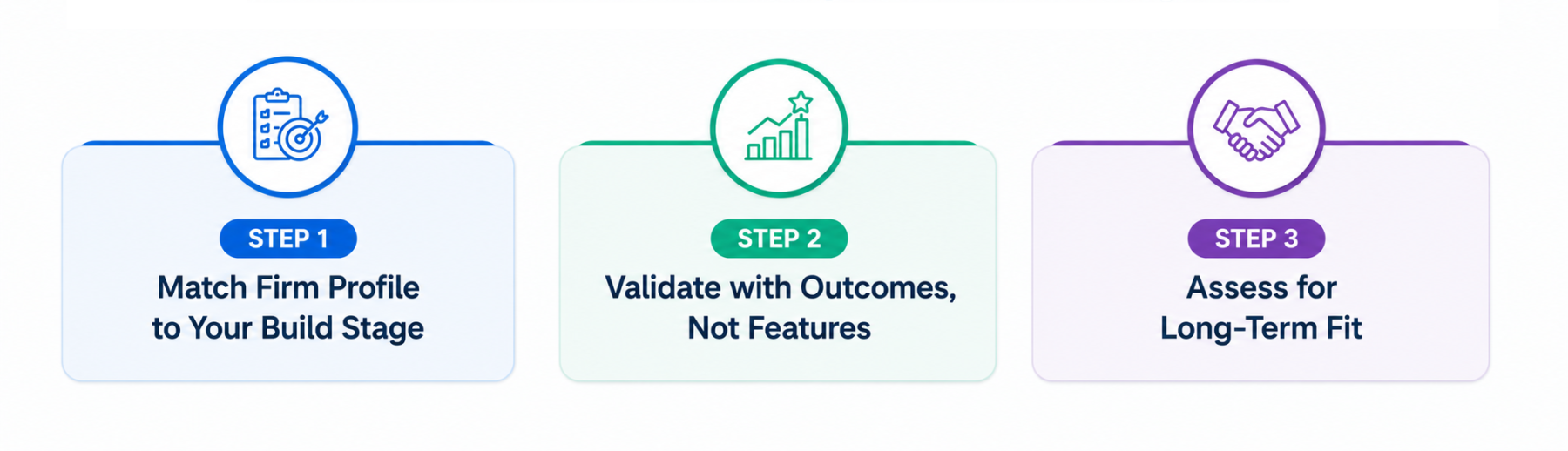
With so many options available, the selection process can feel overwhelming. Here is a practical three-step framework to help you make a confident decision.
Step 1 – Match Firm Profile to Your Build Stage
Different firms are suited to different stages of a product's lifecycle. Early-stage startups building their first MVP need a partner that is comfortable with ambiguity, iteration, and lean delivery. Enterprise health networks replacing legacy systems need a partner with deep integration experience and change management capabilities. Match the firm's strengths to where you actually are, not where you hope to be.
Step 2 – Validate with Outcomes, Not Features
Any development company can list impressive-sounding services on its website. What matters is what they have actually delivered. Ask for references from healthcare clients. Ask to see live systems. Ask what went wrong on past projects and how they responded. The quality of a firm's answers to these questions tells you far more than their marketing materials.
Step 3 – Assess for Long-Term Fit
Healthcare software is never finished. You will be updating it, adding modules, responding to regulatory changes, and scaling it for years after the initial launch. The firm you choose is not just a vendor for this project. They are a long-term technology partner. Evaluate their communication style, their documentation practices, their support model, and whether their values align with yours.
TechWize – Your Trusted Healthcare Software Development Company in Australia
Founded in 2000, TechWize is one of Australia's most experienced Healthcare Software Development Solutions providers, delivering compliant, enterprise-grade systems for over two decades.
TechWize combines deep knowledge of Australian regulatory requirements with a long-term delivery mindset, making them the right partner whether you are building a new digital health product or modernizing legacy infrastructure.
If you are comparing Software Development Companies for your next healthcare project, explore TechWize's services and start the conversation today.
Read Similar Blog

Streamlining Mobile App Development: A Deep Dive into CI/C
Explore More Development Insights ⬩➤Conclusion: Choosing the Right Healthcare Software Development Company
The Australian healthcare technology market in 2026 demands more than capable developers. It demands partners who understand compliance, clinical workflows, long-term system sustainability, and the real-world stakes of software that clinicians and patients depend on daily.
The eight companies listed in this guide each bring distinct strengths. Your task is to match the right partner to your stage, your budget model, and your long-term digital health vision.
Review pricing structures carefully, check independent client reviews on Clutch and GoodFirms, confirm post-launch support terms, and always choose a firm that treats your project as a long-term commitment rather than a one-time delivery.