
 501, Fifth Avenue, Suite 805 New York, NY 10017
 info@techwize.com
 +1 (949) 887-0154
 TechWize

Why 2026 Is a Defining Year for Field Service Transformation
Field service has evolved from simple break-fix operations into a strategic function that directly impacts customer loyalty, operational efficiency, and long-term brand reputation. As we move into 2026, organizations face growing pressure to resolve issues faster, minimize asset downtime, and shift toward proactive service models-all while managing increasing operational complexity.
This shift is being driven by Microsoft Dynamics 365 services, where Artificial Intelligence and Copilot capabilities are reshaping how modern service organizations operate. Field service teams are no longer limited to reactive, manually intensive processes. Instead, AI enables predictive insights, real-time intelligence, and continuous optimization across the service lifecycle, helping organizations respond faster and operate with greater precision.
With AI embedded across planning, execution, and analytics, Dynamics 365 Field Service is evolving from a traditional service management application into a decision intelligence platform. Organizations adopting a structured Microsoft Dynamics 365 implementation are able to standardize service workflows, improve data accuracy, and create a scalable foundation that supports both current operations and future innovation.
Challenges in Traditional Field Service Operations
Prior to AI-led modernization, field service operations were constrained by structural inefficiencies that limited scalability and service quality.
Scheduling and dispatch decisions were largely rule-based and static, failing to account for real-time variables such as technician location, traffic conditions, or skill alignment. This often resulted in delayed response times and inefficient workforce utilization. Maintenance strategies were predominantly reactive. Assets were repaired only after failure, leading to unplanned downtime and emergency service costs.
Additionally, service data was fragmented across systems. Asset history, customer records, inventory data, and service documentation often existed in silos, forcing technicians to spend excessive time searching for information rather than resolving issues.
These limitations made it clear that traditional systems were no longer sufficient for modern service demands.
Role of AI in Modern Dynamics 365 Field Service
AI transforms field service by shifting operations from execution-centric to intelligence-led models.
Within Microsoft Dynamics 365 Services, AI continuously analyzes historical service data, asset performance trends, technician activity, and external signals such as IoT telemetry. This allows organizations to anticipate issues, optimize resource allocation, and adapt service plans dynamically throughout the day.
Instead of reacting to breakdowns, organizations can now predict failures. Instead of static schedules, dispatch plans evolve in real time. Instead of manual reporting, insights are generated automatically.
According to McKinsey, organizations applying AI to service operations achieve
-
20–30% improvement in first-time fix rates
-
Up to 25% reduction in service response times
-
30% lower operational service costs
(McKinsey & Company, AI in Operations, 2024)
AI is no longer an add-on it is the foundation of scalable field service transformation.
What is Copilot in Dynamics 365 Field Service?
Microsoft Copilot is an AI-powered assistant embedded across the Dynamics 365 ecosystem, designed to simplify complex tasks through natural language interaction and contextual intelligence. By augmenting user workflows with real-time insights and intelligent recommendations, AI is also transforming CRM processes within Microsoft Dynamics 365 enabling faster decision-making, improved data accuracy, and more efficient customer engagement.
In field service scenarios, Copilot functions as a real-time digital collaborator. It understands intent, evaluates relevant data, and delivers actionable recommendations without requiring users to navigate multiple dashboards or reports.
For example, dispatchers can ask questions such as “Which technician can resolve this issue within the next hour?” Copilot evaluates skills, location, availability, and SLA commitments to provide optimal recommendations.
Technicians benefit from AI-generated work order summaries, asset history insights, and next-best-action suggestions directly within their workflow.
“Copilot turns enterprise software from systems of record into systems of intelligence.”
- Microsoft Business Applications Group, 2024
Key AI and Copilot Capabilities Transforming Field Service in 2026
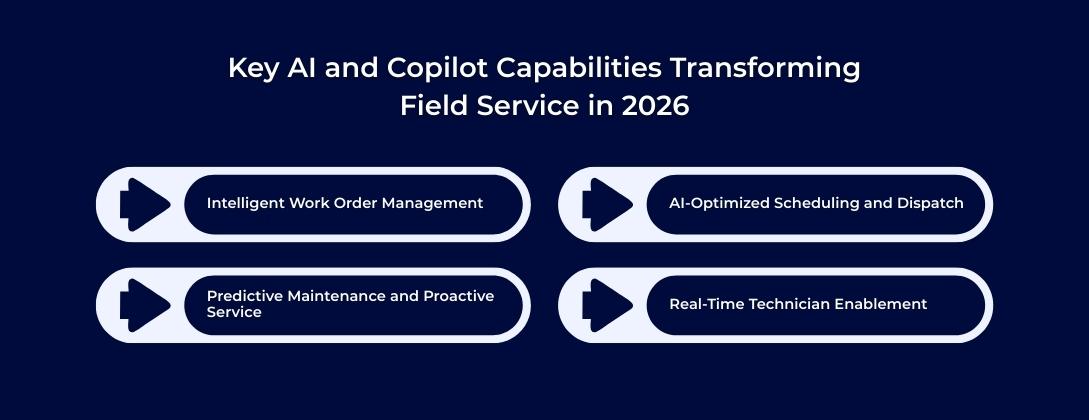
Intelligent Work Order Management
In 2026, work orders are no longer static records. AI automatically generates and enriches them using data from service requests, emails, IoT alerts, and customer interactions. Copilot ensures each work order includes accurate prioritization, asset context, and recommended actions.
Microsoft research indicates that AI-assisted work order automation reduces manual data entry by up to 45% while improving data accuracy (Microsoft Learn – Dynamics 365 Field Service AI Capabilities).
AI-Optimized Scheduling and Dispatch
AI-driven scheduling evaluates technician skills, certifications, real-time location, traffic conditions, asset criticality, and SLA constraints simultaneously. Unlike traditional engines, AI recalculates assignments continuously as conditions change.
Organizations using AI-based scheduling report 15–25% improvements in workforce utilization and fewer missed appointments (IBM, AI in Workforce Optimization, 2024).
Predictive Maintenance and Proactive Service
Predictive maintenance uses AI to identify early signs of asset degradation by analyzing historical failures and real-time sensor data.
|
Maintenance Approach |
Operational Impact |
|
Reactive |
High downtime, emergency costs |
|
Preventive |
Scheduled, moderate efficiency |
|
Predictive (AI-driven) |
Minimal downtime, lowest risk |
Predictive strategies reduce emergency repairs and extend asset lifespan, improving customer satisfaction and operational stability (Microsoft Industry Cloud for Manufacturing, 2024).
Real-Time Technician Enablement
Copilot provides technicians with contextual intelligence at the point of service. Instead of navigating manuals or historical logs, technicians receive concise AI-generated summaries, guided repair steps, and safety recommendations.
This directly improves first-time fix rates and reduces reliance on senior staff for escalation.
Benefits of Different Stakeholders using Dynamics 365 Field Service
Impact on Field Technicians - Reduced Friction and Higher Productivity
For field technicians, the most immediate improvement comes from the reduction of administrative and cognitive workload. Traditionally, technicians spent a significant portion of their day updating work orders, documenting service activities, and searching for historical asset information. These tasks, while necessary, reduced the time available for actual service delivery.
With AI and Copilot, technicians receive concise, AI-generated summaries of work orders that include asset history, past issues, and recommended actions. Service documentation is partially automated, allowing technicians to capture accurate service notes with minimal manual effort. As a result, technicians can focus on resolving issues efficiently and safely, rather than managing systems.
Over time, this leads to improved first-time fix rates, fewer errors, and higher job satisfaction—an important factor in industries facing skilled labor shortages and technician burnout.
Operational Advantages for Service Leadership - Visibility and Control
Service managers and dispatchers operate in environments where real-time decisions directly affect cost, SLA performance, and customer satisfaction. AI transforms this role by replacing intuition-based decisions with data-driven intelligence.
AI-powered dashboards provide continuous visibility into technician availability, job progress, asset health, and potential SLA risks. Copilot enables managers to ask natural-language questions—such as identifying high-risk work orders or optimizing daily schedules—and receive immediate, actionable insights.
Intelligent scheduling further enhances control by dynamically assigning technicians based on skills, certifications, location, and urgency. This reduces idle time, minimizes travel inefficiencies, and improves overall workforce utilization. For leadership teams, these capabilities enable predictable operations, accurate forecasting, and scalable service models without linear increases in headcount.
Customer Experience Outcomes - Faster Resolution and Greater Trust
From the customer’s perspective, the benefits of AI-driven field service are both immediate and tangible. Faster response times ensure issues are addressed promptly, while intelligent technician assignment increases the likelihood of first-time resolution, reducing repeat visits and service disruptions.
Predictive maintenance plays a critical role in improving customer trust. Instead of reacting to unexpected breakdowns, organizations can proactively service assets before failures occur, often during non-disruptive hours. Customers also benefit from transparent communication, real-time updates, and consistent service quality.
Collectively, these improvements elevate service from a reactive support function to a value-driven experience that strengthens long-term customer relationships and brand credibility.
Real-World Use Cases and Scenarios of Dynamics 365
Manufacturing
AI enables manufacturers to continuously monitor asset performance and identify early indicators of equipment failure. By predicting issues before breakdowns occur, maintenance can be scheduled during planned downtime or low-production windows. This approach reduces unplanned outages, protects production schedules, and extends the operational lifespan of critical machinery.
Utilities
Utilities use AI-powered intelligent dispatch to respond faster during service outages and infrastructure disruptions. The system evaluates technician location, skills, availability, and real-time conditions to assign the most qualified resources immediately. This accelerates service restoration, improves grid reliability, and enhances customer confidence during high-impact events.
Healthcare Equipment
Healthcare equipment providers rely on Copilot-guided workflows to support compliance-driven maintenance and strict regulatory requirements. AI ensures technicians follow standardized procedures, access accurate equipment history, and document service actions correctly. This minimizes equipment downtime, supports patient safety, and helps organizations maintain compliance without disrupting clinical operations.
Facilities Management
Facilities management organizations use predictive servicing to shift from reactive maintenance to proactive asset care. AI analyzes usage patterns, environmental data, and historical performance to anticipate failures. This reduces emergency callouts, lowers operating costs, improves energy efficiency, and ensures consistent performance across large, multi-site facilities.
Future Outlook - What’s Next Beyond 2026?
Field service is moving toward semi-autonomous operations, AI agents managing end-to-end workflows, self-diagnosing assets, and digital twins simulating service outcomes.
Looking ahead, businesses that partner with TechWize for Microsoft Dynamics 365 Consulting are better positioned to align AI capabilities with their operational goals and industry-specific requirements. Through targeted Microsoft Dynamics 365 Customization, Techwize helps organizations adapt field service processes to real-world scenarios while maintaining the flexibility to integrate with broader enterprise ecosystems, including platforms such as Salesforce Development Services.
Conclusion - The AI Future of Dynamics 365 Field Service
AI and Copilot are fundamentally redefining Microsoft Dynamics 365 Field Service by shifting service operations from reactive execution to predictive, intelligence-driven models. Through advanced automation, real-time insights, and natural language assistance, organizations can optimize workforce utilization, reduce asset downtime, and consistently meet SLA commitments. As service complexity increases, AI-powered decision intelligence enables leaders to plan proactively, technicians to work more efficiently, and customers to receive faster, more reliable service. Organizations that invest in Microsoft Dynamics 365 Field Service today are not only modernizing service delivery but also building a scalable foundation for innovation, resilience, and long-term growth in an increasingly service-driven economy. With secure identity management becoming a critical part of connected service environments, solutions like Microsoft Authentication Broker help organizations strengthen authentication workflows and maintain secure access across enterprise applications.
As enterprises continue adopting AI-powered technologies and digital transformation strategies, accessing reliable technology insights and industry resources helps decision-makers stay informed about emerging solutions, best practices, and innovations shaping the future of enterprise IT.