
 501, Fifth Avenue, Suite 805 New York, NY 10017
 info@techwize.com
 +1 (949) 887-0154
 TechWize

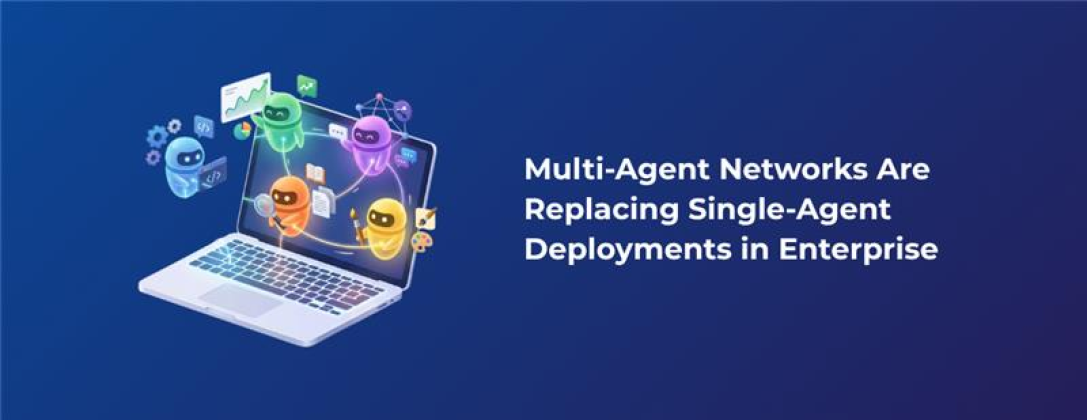
Businesses in the United States are changing how they work. For years, companies have tried to make their daily tasks faster and cheaper using technology. Now, we are seeing a massive shift in how companies use artificial intelligence. In the past, businesses bought a single AI tool to perform a specific job. Today, the smartest companies are connecting many AI tools so they can communicate and solve big problems as a team. This shift is called moving from single-agent deployments to multi-agent networks. For any large company looking to stay ahead, understanding this change is the first step toward true enterprise AI automation.
Understanding the Old Way – Single-Agent Deployments
To understand why things are changing, we have to look at how things used to be. A single-agent deployment is exactly what it sounds like: you deploy one AI program to handle one specific task. Think of it like hiring one very smart worker who knows only one thing on an assembly line.
For example, a company might use a single AI agent to read incoming customer emails. Another single AI agent might be used only to write monthly sales reports. These single agents are good at what they do, but they work in a closed box. They cannot see what the other agents are doing, nor can they ask for help when a task becomes too hard.
Reaching New Heights – How the Limits of Single Agents Drive Innovation
Over the last few years, American businesses pushed single-agent systems to their absolute limits. Companies tried to make these single agents do more and more, but eventually, they hit a wall. Innovation is now being driven by the simple fact that one AI agent is not enough for the modern business world.
Recognizing the Need for Broader Capabilities
A single AI agent might be great at finding a customer’s order number. But what happens when the customer wants to return the item, change their shipping address, and apply a store credit all at once? A single agent gets confused because it lacks broader capabilities. It was not built to handle a mix of different problems.
Shifting from Simple Tasks to Complex Enterprise Goals
Business goals are not simple anymore. A company does not just want to “send an email.” The goal is to “increase customer retention by solving complex problems without human delay.” Single agents were built for simple tasks. When enterprises shifted their focus to complex, multi-step goals, the single-agent model broke down.
Inspiring the Search for Better Collaborative Tools
Because single agents kept failing at complex tasks, technology leaders started looking for a better way. They realized that human businesses do not rely on one person to do everything. A business has a sales team, an IT team, and a billing team. This inspired tech builders to create collaborative tools that let different AI programs work together like a human team.
Enter the New Era – Why Enterprises Are Moving to Multi-Agent Networks
A multi-agent network is a system where multiple AI agents are connected. They share information, divide the work, and check each other’s mistakes. Enterprises across the USA are moving to this model for several major reasons.
Increasing Complexity of Business Operations
Business operations today are deeply complex, especially with global supply chains and strict rules. A multi-agent network can handle this. One agent can monitor shipping delays, another can check legal compliance, and a third can adjust the budget. They work together to handle complex operations that would overwhelm a single agent.
Need for Real-Time Decision Making
In the American market, speed is everything. If a stock drops or a server goes down, companies cannot wait for a single AI agent to process the data slowly. Multi-agent networks enable real-time decision-making. Because the agents divide the data and work together, they can spot problems and make decisions in the blink of an eye.
Demand for Scalability
When a business grows, its technology needs to grow with it. With single-agent systems, you often have to build a completely new AI tool from scratch when you add a new department. Multi-agent networks are highly scalable. If your company expands, you add a new specialized agent to the existing network. It plugs right in and starts working with the rest of the team.
Improved Accuracy and Efficiency
Single agents can make mistakes, and because they work alone, no one is there to correct them. In a multi-agent network, you can have a “reviewer” agent. Agent A writes the report, and Agent B checks the math before it goes to the human manager. This back-and-forth teamwork greatly improves accuracy and overall efficiency.
Enhanced System Reliability
If a single-agent system crashes, the whole process stops. In a multi-agent network, the system is much stronger. If one agent goes offline, the other agents can pick up the slack, or the system can safely pause just that one task while the rest of the business keeps running smoothly.
How Multi-Agent Networks Actually Work Together
It helps to think of a multi-agent network like a busy restaurant kitchen. You do not have a single chef making every part of the meal. You have a prep cook, a fry cook, a grill cook, and a pastry chef. They all work in the same kitchen, passing ingredients back and forth to create a perfect final meal.
AI agents work the same way. They use application programming interfaces (APIs) and secure data channels to exchange information. They can send text, numbers, and commands to each other in milliseconds. They do not have feelings, but they are programmed to share data seamlessly to reach a shared business goal.
Core Components of a Multi-Agent Network
Every good multi-agent network has three main parts. First, there are the specialized agents, which are the AI tools built for specific tasks (like data analysis or writing). Second, there is the communication layer, the secure “highway” that the agents use to communicate with each other. Third, there is a shared memory or data pool that all agents can read to access the same company information, so everyone is on the same page.
The “Manager Agent” Concept – Bringing Order to Chaos
If you have twenty AI agents talking at once, it can get messy. That is why most multi-agent networks use a “Manager Agent.” Think of this as the shift supervisor. The Manager Agent does not do the heavy lifting of writing code or analyzing data. Instead, it receives the large request from the human user, breaks it down into smaller tasks, assigns those tasks to the appropriate worker agents, and then collects the final results to present to the human user. This brings perfect order to what would otherwise be chaos.
Steps to Transition from Single-Agent to Multi-Agent Systems
Moving to a multi-agent system is a journey. American enterprises should follow a clear path to make sure the transition is smooth and actually helps the business.
Assess Current AI and Automation Capabilities
Before building anything, a company must look at what it already has. You need to map out all your current single-agent tools. Figure out what they do well and where they are failing. This tells you exactly what gaps need to be filled.
Identify High-Impact Use Cases for Multi-Agent Systems
Do not try to change the whole company at once. Pick one or two areas where a multi-agent system will have the biggest impact. For many companies, this is customer service or supply chain management. Find the biggest pain point and start there.
Design the Multi-Agent Framework and Agent Roles
Once you know what you want to fix, you have to design the team. What agents do you need? Who is the Manager Agent? Who does the research? Who does the writing? Mapping out the roles clearly before you write any code is the secret to success.
Develop and Deploy Using AI Agent Development Services
Building these networks is hard. It requires great technical skill in AI models, data security, and system integration. This is exactly why companies turn to expert AI Agent Development Services. These specialized tech teams write the code, connect the agents safely, and deploy the network into your company’s existing systems without breaking anything.
Monitor Performance and Continuously Improve
After the network is live, the work is not over. You have to watch how the agents interact. Are they passing information correctly? Are they making mistakes? You must constantly monitor the system and update the agents to make them smarter over time.
Key Differences Between Single-Agent and Multi-Agent Systems
The differences are clear when you look at them side by side:
- Focus: A single agent focuses on one narrow task. A multi-agent system focuses on a broad, complex business outcome.
- Communication: Single agents work in total isolation. Multi-agent systems rely on continuous communication and data sharing.
- Problem Solving: A single agent fails if a problem falls outside its exact programming. A multi-agent system hands the problem to another agent who knows how to solve it.
- Scalability: Single agents require a full rebuild to do new things. Multi-agent systems let you add new agents as your needs grow.
Role of AI Agent Development Services in Building Multi-Agent Systems
You cannot buy a multi-agent network-in-a-box off the shelf. Every business is different, which means every network must be custom-built. Professional AI Agent Development Services play a crucial role here. These service providers understand how to select the right underlying AI models (such as large language models) for each specific agent. They build secure bridges that allow agents to communicate safely. Most importantly, they make sure the AI follows your company’s rules and keeps your data private, which is a massive concern for enterprises in the United States.
Importance of Next-Gen AI Consulting Services in Enterprise Transformation
Building the tech is only half the battle. Before a single line of code is written, a company needs a strategy. This is where the next-gen AI Consultant comes in. Good consultants look at your business from the top down. They help you figure out if you even need a multi-agent system, or if a simpler fix will work. They calculate the return on investment (ROI) and help train your human staff to work alongside AI. Without proper consulting, companies often waste millions of dollars building the wrong AI tools. With the right guidance, enterprise AI automation becomes a smooth, profitable transformation rather than a costly science experiment.
Future Trends – From Networks to Autonomous Ecosystems
The future of this technology is incredibly exciting. Right now, multi-agent networks mostly rely on humans to provide the initial command. In the near future, these networks will evolve into fully autonomous ecosystems. Imagine a system where an AI agent notices that a product is running low in a warehouse, automatically talks to a purchasing agent to order more, talks to a finance agent to approve the budget, and talks to a logistics agent to schedule the delivery—all without a human ever pressing a button. We are moving toward AI systems that can manage entire sections of a business independently.
How TechWize Can Help with Multi-Agent AI Deployment
If your American enterprise is ready to leave single-agent systems behind, TechWize is here to guide you. We understand that true automation does not happen in a vacuum; it has to connect with the software your business already uses. For example, we specialize in Sage Copilot Implementation, helping your finance and operations teams bring smart AI directly into their daily accounting workflows.
Furthermore, if your business relies on customer relationships and sales, we offer expert Salesforce Agentforce Services. We can help you build custom AI agents that live right inside your Salesforce environment, interact with your customer data, and close deals faster. All of this is backed by our deep expertise in traditional ERP and CRM services, ensuring that your new multi-agent networks have a rock-solid foundation of clean, organized business data to work with. TechWize does not just give you AI tools; we weave them into the fabric of your business.
Conclusion – Embracing the Future with Multi-Agent Networks
The shift from single-agent deployments to multi-agent networks is not just a small tech update. It is a complete change in how businesses operate. Single agents were a great starting point, but they cannot keep up with the complex, fast-paced demands of modern enterprises. By using multi-agent networks, companies can achieve better accuracy, make faster decisions, and scale their operations like never before. As AI technology continues to grow, the businesses that learn to build and manage these AI teams today will be the undisputed industry leaders of tomorrow. Embracing multi-agent networks is no longer an option for the future; it is the necessary step for right now.