
 501, Fifth Avenue, Suite 805 New York, NY 10017
 info@techwize.com
 +1 (949) 887-0154
 TechWize
For years, enterprise AI meant one chatbot trying to handle everything a customer or employee could throw at it. That model changed on June 15, 2026, when Salesforce brought Multi-Agent Orchestration in Agentforce to general availability as the centerpiece of its Summer '26 release (source: Tech Times). The update marked a formal shift for Salesforce's enterprise AI platform, moving it from single chatbots to coordinated teams of specialist agents working behind one interface.
This is not a minor feature update. It is a structural change in how Salesforce Agentforce Services are designed, deployed, and scaled inside large organizations. Instead of one agent absorbing every task, businesses can now build focused, single-purpose agents that hand work to each other automatically, guided by a central orchestrator. For companies already running Agentforce or evaluating Salesforce Agentforce Agent Development for the first time, understanding this shift is quickly becoming a competitive necessity rather than a nice-to-have.
This blog breaks down what Salesforce Agentforce Multi-Agent Orchestration actually is, why enterprises are adopting it, how it works step by step, and what to plan for before scaling it across your organization.
What Is Multi-Agent Orchestration in Salesforce Agentforce?
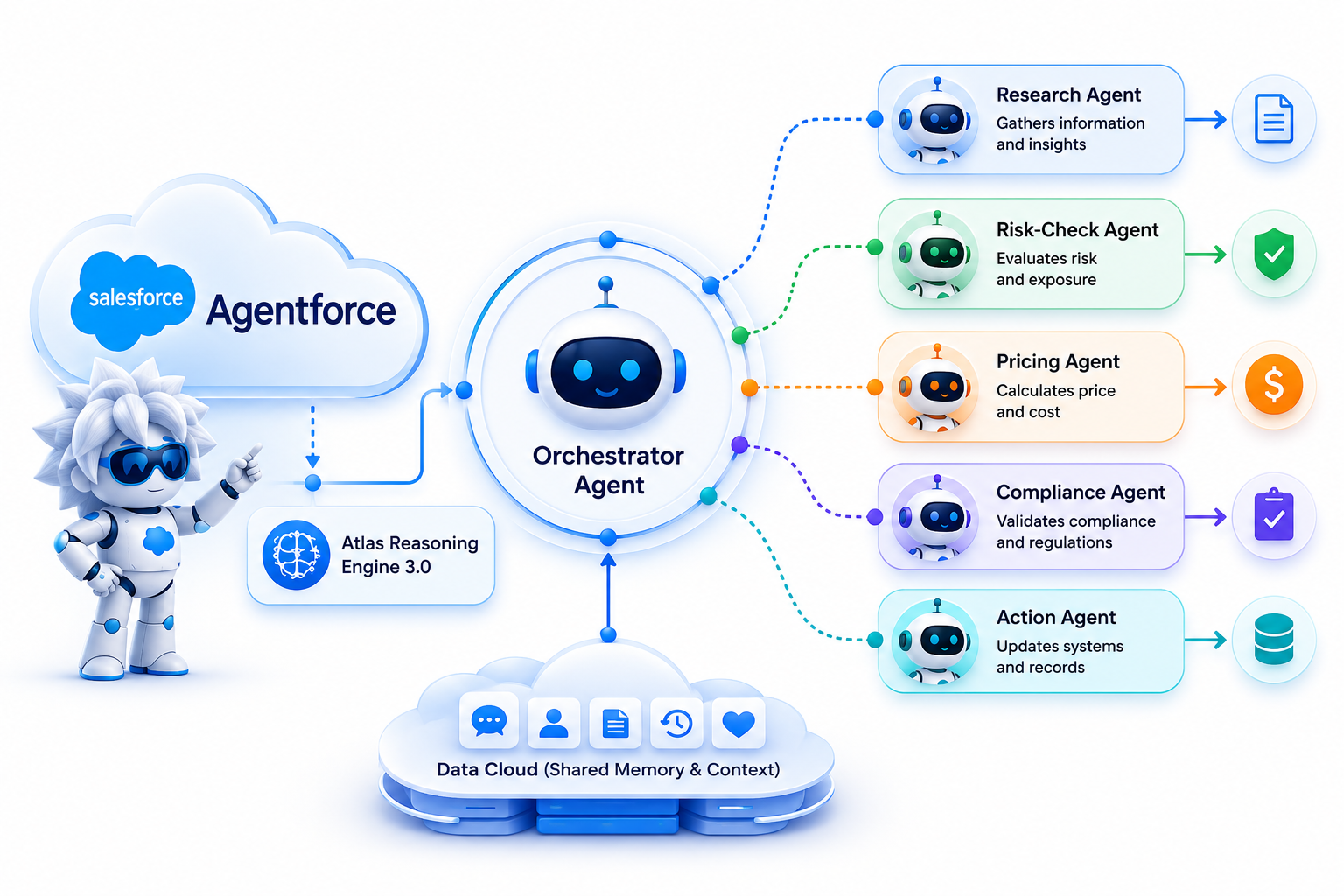
Multi-Agent Orchestration in Salesforce Agentforce is the coordination layer that allows several specialized AI agents to work together on a single request, instead of one general-purpose bot attempting to do it all. A dedicated orchestrator agent decides which specialist agent should respond to a given request, and the person on the other end never sees the handoff. They experience one continuous conversation, whether it moves across web chat, email, WhatsApp, Slack, or Microsoft Teams.
Under the hood, this coordination is powered by the Atlas Reasoning Engine 3.0, which routes tasks by reading each specialist agent's plain-language description rather than relying on fixed decision trees. That detail matters more than it sounds: description quality and data hygiene now directly determine whether a request gets routed to the right agent, which makes careful Salesforce Agentforce Agent Development a foundation for reliability, not an afterthought (source: Tech Times).
Agents also share context and hand off tasks through a central orchestration layer, with shared memory built into Data Cloud, so no specialist agent is working blind (source: Cyntexa). This is the practical meaning of multi-agent AI orchestration inside Agentforce: fewer isolated bots, more coordinated digital labor.
Key Benefits of Multi-Agent AI Orchestration for Salesforce Agentforce Services
Enterprises are not adopting multi-agent AI orchestration for novelty. The benefits map directly to problems that single-agent systems could never fully solve.
Faster Resolution Through Specialized Agents in Multi-Agent AI Orchestration
Each agent owns one job, so it can be tuned, tested, and improved without touching unrelated logic elsewhere in the system. This focus is what allows Salesforce Agentforce Services to resolve requests faster than a single, overloaded bot trying to manage every scenario.
Shared Enterprise Memory Across Salesforce Agentforce Agent Development
Agents draw from the same underlying data and conversation history, so customers and employees are not forced to repeat themselves as a request moves between specialists. This shared context is a core outcome of well-planned Salesforce Agentforce Agent Development, where memory is architected at the platform level rather than trapped inside individual bots.
Cross-Agent Validation That Strengthens Multi-Agent Orchestration Accuracy
Because multiple agents can review, enrich, or check each other's outputs before execution, errors are more likely to get caught before they reach a customer or a business system. This built-in validation is one of the clearest accuracy advantages multi-agent orchestration holds over single-agent design.
Centralized Governance Built Into Salesforce Agentforce Services
Authentication, authorization, and audit logging can be enforced consistently across every agent, rather than configured separately inside each bot. Centralized governance is a major reason enterprise IT and compliance teams are more comfortable scaling Salesforce Agentforce Services company-wide.
Modular Scaling Within Salesforce Agentforce Integration
Businesses can introduce a new specialist agent for a new use case without re-architecting the agents already in production. This modularity keeps Salesforce Agentforce Integration flexible over time, since new capabilities can be layered in as business needs evolve.
Together, these benefits are why Salesforce Agentforce Services built around orchestration, rather than standalone bots, are becoming the default expectation for enterprise-grade AI deployments.
Single Agent vs Multi-Agent AI Orchestration: Why Salesforce Agentforce Services Are Moving Beyond One-Bot Systems
| Capability | Single AI Agent | Multi-Agent AI Orchestration |
| Task Handling | Handles one broad task alone | Coordinates multiple specialized agents |
| Context | Limited, often resets between requests | Shared enterprise memory across agents |
| Scalability | Difficult to extend without rework | Modular architecture, agents added independently |
| Governance | Minimal, configured per bot | Central policy enforcement across all agents |
| Accuracy | Higher hallucination risk | Cross-agent validation before execution |
| Maintenance | Harder to update without side effects | Individual agents can evolve independently |
| Enterprise Integration | Limited connection to core systems | Designed for enterprise applications and workflows |
This comparison is exactly why forward-looking Salesforce Agentforce Services are steering clients away from monolithic bot deployments and toward orchestrated, multi-agent architectures from the start of a project, not as a later redesign.
Key Challenges Enterprises Must Address Before Scaling Multi-Agent AI Orchestration in Salesforce Agentforce
Multi-agent orchestration solves real problems, but it introduces its own operational demands. Enterprises moving from pilot to production should plan for the following.
Hallucination Management Across Multi-Agent AI Orchestration Handoffs
More agents mean more points where inaccurate output could pass downstream if validation is not designed carefully. Managing this risk requires checkpoints built into the orchestration layer itself, not left to individual agents to self-correct.
Identity, Access Control, and Data Privacy in Agentforce Agent Development
Each agent needs permissions scoped correctly so no specialist has more access than their job requires. Getting this right during Salesforce Agentforce Agent Development prevents privilege creep as more agents are added over time.
Cross-Agent Consistency in Salesforce Agentforce Multi-Agent Orchestration
Since routing depends on how an agent describes itself, outdated or vague descriptions can silently misroute requests. Keeping agent descriptions accurate and current is an ongoing maintenance task, not a one-time setup step.
Cost Optimization for Scaling Multi-Agent AI Orchestration
Coordinated agents processing thousands of daily interactions can add up quickly without usage monitoring in place. Enterprises need visibility into token consumption per agent to keep orchestration cost-efficient at scale.
Regulatory Compliance and Audit Readiness in Salesforce Agentforce Services
Regulated industries need every agent's decision to be traceable and explainable after the fact. This makes audit-ready logging a non-negotiable requirement for Salesforce Agentforce Services deployed in finance, healthcare, or insurance.
Human Oversight for High-Risk Decisions in Multi-Agent Orchestration
Financial transfers, healthcare recommendations, and regulatory reporting still need a human checkpoint before execution. No amount of orchestration sophistication should remove a human from decisions with real financial or personal consequences.
Legacy System Integration Beyond Salesforce Agentforce Integration
Many enterprises run core operations on SAP, ServiceNow, or custom systems that were never built with agent orchestration in mind. Extending Salesforce Agentforce Integration to these legacy environments is often the hardest and most overlooked part of a rollout.
This last point is worth underlining given how fast the AI agent landscape is expanding across platforms. Enterprises already running ServiceNow AI Agents alongside Agentforce, for instance, need an integration strategy that accounts for both environments working together rather than in isolation.
Why Enterprises Are Investing in Multi-Agent AI Orchestration
The adoption numbers behind this shift are no longer speculative. Agentforce's annual recurring revenue reached 800 million dollars, growing 169 percent year-over-year, while total AI revenue crossed 2.9 billion dollars (source: Salesforce Newsroom via Enterprise DNA). Salesforce also closed 29,000 Agentforce deals over the past year and logged 2.4 billion agent-driven work units across Agentforce and Slack combined (source: Enterprise DNA).
Adoption is not limited to customer-facing use cases either. Custom AI agents built on Slack have grown 300 percent since January 2026, reflecting how quickly employees are pulling agent-driven workflows into everyday tools rather than treating them as a separate system (source: Cyntexa). Salesforce has also added support for the Agent2Agent protocol, allowing Agentforce agents to communicate with agents built on entirely different platforms, which means an orchestrator is no longer limited to working with Salesforce-native agents alone (source: Enterprise DNA).
At the same time, broader industry research shows the opportunity is far from fully captured. Eighty-three percent of organizations report that most or all of their teams have adopted AI agents in some form, yet fifty percent of agents still operate in isolated silos rather than as part of a coordinated multi-agent system, which creates disconnected workflows and shadow AI risk (source: Salesforce Newsroom, Connectivity Report 2026). That gap between adoption and coordination is exactly where multi-agent AI orchestration delivers its return on investment.
How Multi-Agent AI Orchestration Works in Salesforce Agentforce Agent Development
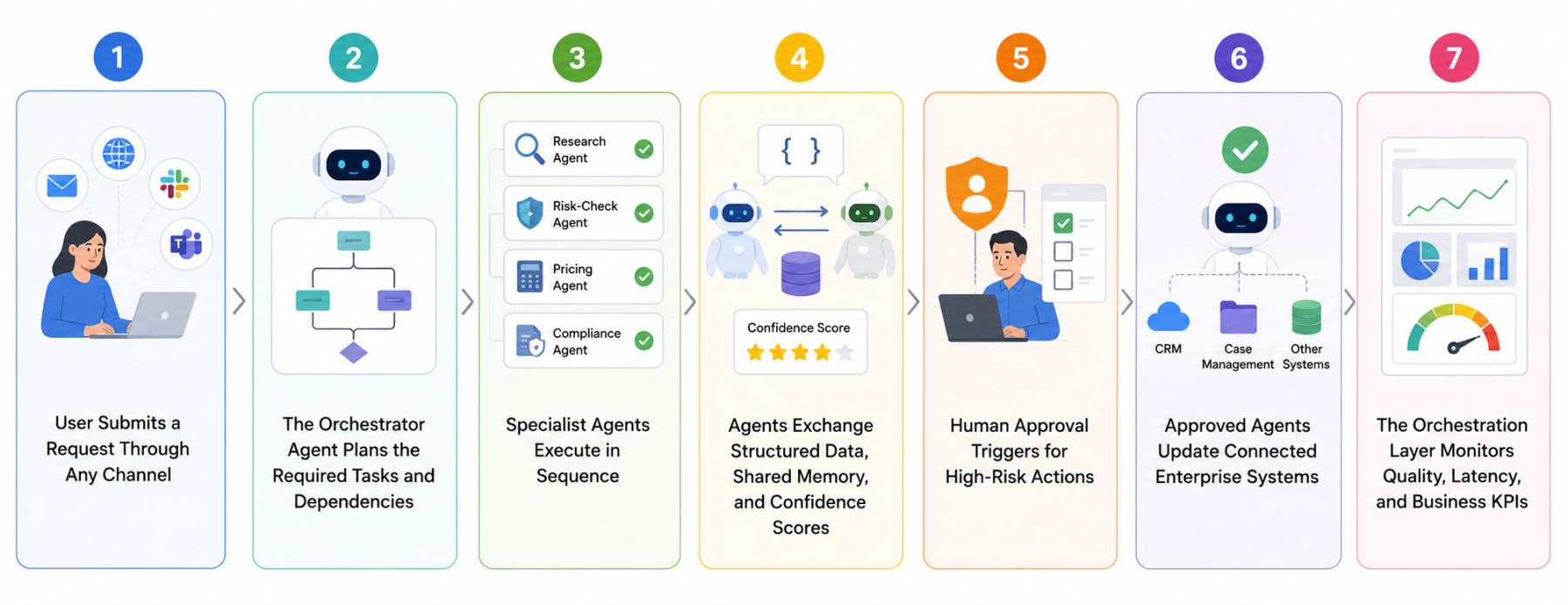
Understanding the mechanics helps clarify why careful Salesforce Agentforce Agent Development matters so much once orchestration is involved. A typical request moves through seven coordinated steps, and each step plays a distinct role in making sure the outcome is accurate, traceable, and safe to execute.
Step 1: User Submits a Request Through Any Channel
Every orchestrated workflow begins the same way: a person submits a request, and the channel they use does not change what happens behind the scenes. Whether the interaction starts in web chat, email, Slack, or Microsoft Teams, Agentforce treats the entry point as a front door rather than a fixed pathway. This channel-agnostic design is what allows the same orchestration logic to serve a customer on a website and an employee inside Slack without maintaining separate systems for each.
Step 2: The Orchestrator Agent Plans the Required Tasks and Dependencies
Once a request comes in, the orchestrator agent takes over as the planning layer. It determines what needs to happen, in what order, and which specialist agents are needed to complete the request end to end. This planning step is where the Atlas Reasoning Engine reads each specialist agent's description to decide the correct routing path, which means the quality of that planning depends heavily on how clearly each agent's role has been defined during development.
Step 3: Specialist Agents Execute in Sequence
With a plan in place, individual specialist agents begin doing the actual work, each contributing a narrow piece of expertise rather than attempting the full task alone. For example, a research agent gathers information, a risk-check agent evaluates exposure, a pricing agent calculates cost, and a compliance agent validates the result before anything moves forward. Because each agent focuses on a single responsibility, errors are easier to isolate and fix without disrupting the rest of the workflow.
Step 4: Agents Exchange Structured Data, Shared Memory, and Confidence Scores
As work moves between agents, communication happens through structure rather than casual conversation. Rather than passing free-form text between each other, agents share structured task objects and validation results, which keeps the workflow auditable at every handoff. This structured exchange also carries confidence scores, giving downstream agents and human reviewers a clear signal of how certain the system is about a given output before it proceeds further.
Step 5: Human Approval Triggers for High-Risk Actions
Not every decision is left to the agents alone. Financial transfers, underwriting decisions, and regulatory reporting are flagged for a human checkpoint before execution proceeds, ensuring that high-stakes actions always pass through a person before they take effect. This step is built into the orchestration logic itself, so approval requirements are consistent across every workflow rather than left to individual configuration.
Step 6: Approved Agents Update Connected Enterprise Systems
Once a decision clears any required approval, the workflow moves from analysis into action. This is where orchestration becomes operational, pushing verified outcomes into CRM records, case management tools, or other core systems that the business relies on daily. The update happens automatically at this stage, closing the gap between a decision being made and that decision actually reflecting in enterprise data.
Step 7: The Orchestration Layer Monitors Quality, Latency, and Business KPIs
The workflow does not end once a task is executed. Ongoing monitoring closes the loop, feeding performance data back so the system can be refined over time based on real outcomes rather than assumptions. This continuous feedback is what allows orchestration to improve with use, catching slow response times, degraded accuracy, or shifting business needs before they become larger problems.
This step-by-step structure is what separates orchestrated Salesforce Agentforce Agent Development from simply connecting several standalone bots. The sequence, the handoffs, and the checkpoints are all managed by design rather than assembled after the fact.

Build Your Agentforce Orchestration Roadmap
From agent development to full-stack integration, TechWize helps you plan a multi-agent Agentforce rollout that scales without the usual production headaches. Let our team map out what your orchestration architecture should look like.
Schedule a ConsultationSalesforce Agentforce Integration: Connecting Orchestration to Your Existing Stack
Multi-agent orchestration only delivers value if it connects cleanly to the systems a business already runs on. Salesforce Agentforce Integration extends orchestrated agents into Slack, Microsoft Teams, and the IT Service Desk, and Salesforce's IT Service Domain Pack alone ships more than fifty specialized AI agents out of the box across these channels to detect intent and resolve employee requests (source: Tech Times).
For most enterprises, this integration work does not stop at Salesforce's own tools. Many organizations still rely on existing Salesforce CRM Services and Salesforce Sales Cloud Solutions to manage their core customer data, and orchestrated agents need clean, well-structured access to that data to make accurate decisions. Integration also frequently extends outward, connecting Agentforce orchestration with broader AI Development initiatives across a company's technology stack, so that agentic workflows are not confined to a single department or platform.
Successful Salesforce Agentforce Integration depends less on the number of systems connected and more on data hygiene, clear agent descriptions, and governance built in from day one, since those are the same factors that determine whether the orchestration layer routes requests correctly in the first place.
Hire TechWize for Expert Salesforce Agentforce Services and Agent Development
Rolling out multi-agent orchestration successfully takes more than switching on a feature. It requires designing agent hierarchies that make sense for your business processes, writing clear and accurate agent descriptions so routing stays reliable, integrating orchestration with the CRM and legacy systems already in place, and building governance and monitoring in from the start rather than retrofitting it later.
TechWize works with enterprises on exactly this kind of implementation, offering Salesforce Agentforce Services that cover the end-to-end lifecycle, including agent development, orchestration design, and Salesforce Agentforce Integration with existing Data Cloud and enterprise environments. Rather than applying a generic template, the approach is built around each organization's specific workflows, data structure, and compliance requirements, so orchestration performs reliably once it moves from pilot to production.
If your organization is planning a move from isolated bots to a coordinated, orchestrated Agentforce deployment, talk to TechWize's Agentforce team about what that roadmap should look like for your business.
Read Similar Blog
Salesforce Agentforce Contact Center: Redefining AI Customer Support for the Modern Enterprise
Explore More Salesforce Insights ⬩➤Conclusion: The Future of Multi-Agent AI Orchestration in Salesforce Agentforce
Multi-Agent Orchestration is not an incremental update to Salesforce Agentforce. It is a structural shift in how enterprise AI operates, moving businesses away from single, overloaded bots and toward coordinated teams of specialist agents working under one governed system. The revenue growth, deal volume, and work unit numbers behind this shift make clear that adoption is already well past the experimental stage.
At the same time, the gap between organizations adopting AI agents and organizations actually coordinating them signals where the real opportunity lies over the next few years. Enterprises that invest now in proper Salesforce Agentforce Agent Development, thoughtful Salesforce Agentforce Integration, and governed orchestration design will be the ones positioned to scale confidently as the agentic enterprise becomes the standard, rather than the exception.