
 501, Fifth Avenue, Suite 805 New York, NY 10017
 info@techwize.com
 +1 (949) 887-0154
 TechWize
Here is the thing nobody really says out loud: most finance teams are not struggling because they are bad at their jobs. They are struggling because the tools they are using were never built for how businesses operate now.
Spreadsheets were fine when you had one entity, one currency, and maybe a dozen employees. But the moment you add a second location, a new revenue stream, or investors who want monthly reporting, that old system starts cracking at the seams. And it is not a small crack either. Sage Intacct Implementation has an average rating of about 4.3 out of 5 stars from more than 4,000 reviews on G2 (source: Rand Group), which tells you something. People who actually switched away from manual systems are not shy about saying it was worth it.
What is happening across the industry right now is a shift from finance being a back-office task to finance being a strategic seat at the table. Leadership wants answers today, not next Friday. And honestly, that pressure is not going away. If anything, it is only getting heavier as more businesses compete on speed and data, not just product.
Sage Intacct: Why Cloud-Native Financial Management Matters Right Now
This is where cloud-native software actually earns the hype, and I say that as someone who has seen a lot of "revolutionary" software come and go. Being cloud-native is not just a marketing term; it means the entire platform was built for the cloud from day one, not bolted onto an old system later.
That matters because it means updates happen automatically in the background—no waiting for IT to schedule a weekend upgrade. No paying for servers that sit in a closet somewhere collecting dust. Your team logs in from anywhere, on any device, and sees the same live data. For businesses with remote teams or multiple offices, this alone can save weeks of frustration every year.
And here is a small but real point people miss. Cloud-native systems tend to get smarter faster, because the vendor is constantly rolling out improvements to everyone at once instead of a handful of customers who paid for the newest version.
Core Capabilities of Sage Intacct Implementation for Financial Management
Now let us get into what the software actually does, because features matter more than buzzwords. Here is a section-by-section look at what you actually get.
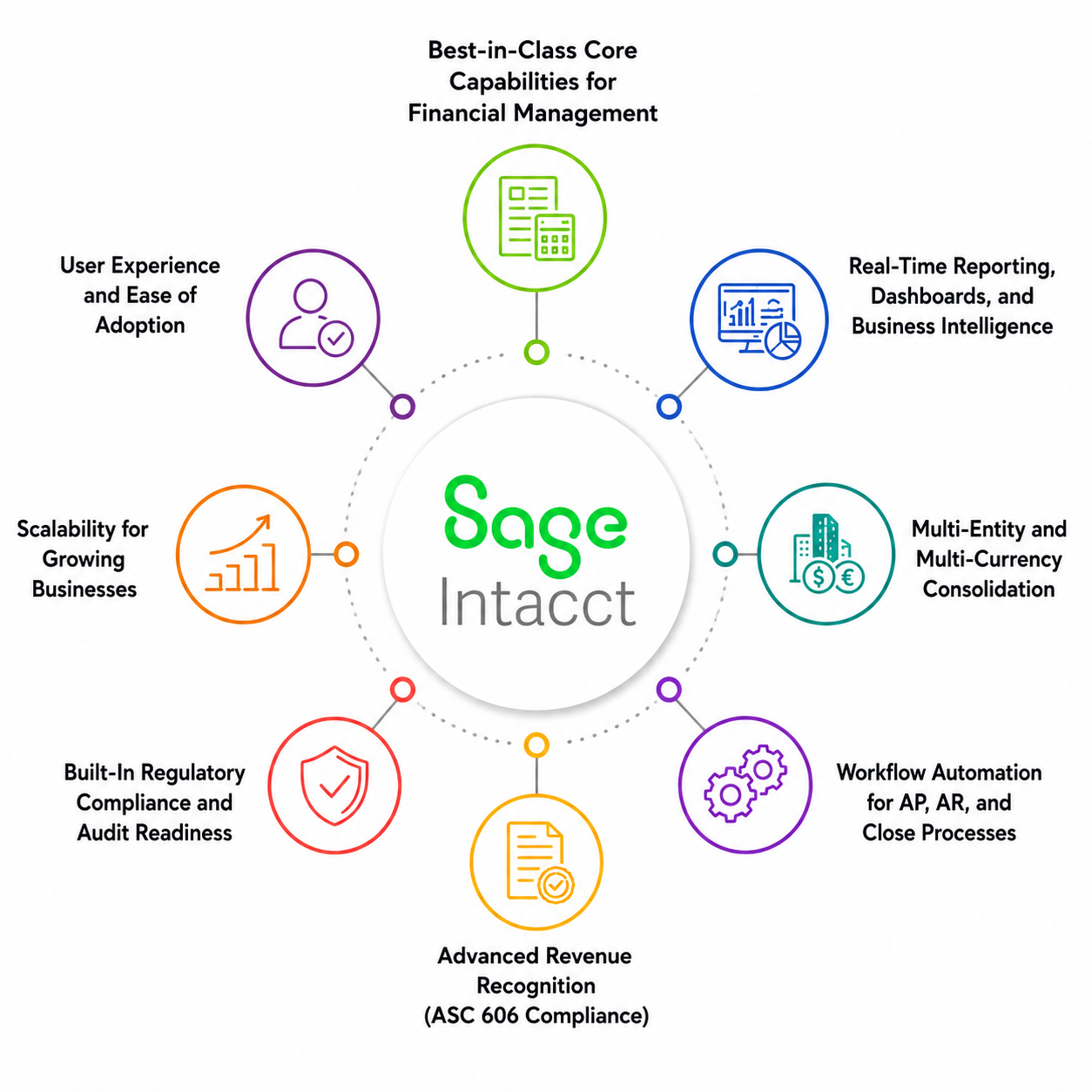
Best-in-Class Core Capabilities for Financial Management
At its core, Sage Intacct gives you best-in-class core capabilities for financial management, meaning the basic stuff,-general ledger, accounts payable, accounts receivable- is not just functional but genuinely well built. A lot of software gets the basics right and stops there. Sage Intacct treats the fundamentals as the foundation everything else builds on, which honestly is rarer than it should be.
Real-Time Reporting, Dashboards, and Business Intelligence
This might be the single biggest reason companies switch. Instead of waiting for someone to compile a report, you open a dashboard, and the numbers are already there, already current. Sage Intacct customers see an average of 2.5x return on investment, with payback in as little as six months, and up to 5x ROI over time (source: Sage). That is not a small number, and it is not marketing fluff either; it shows up in what users actually report.
Multi-Entity and Multi-Currency Consolidation
For businesses operating in more than one place, this turns what used to take days into something that takes minutes. You are not manually converting currencies or reconciling entities by hand anymore. If you have ever closed the books across three entities in three currencies using a spreadsheet, you already know why this alone can be worth the switch.
Workflow Automation for AP, AR, and Close Processes
Nobody enjoys chasing down approvals or manually matching invoices, and automating it frees people up to actually think about the numbers instead of just processing them. It is a quiet feature, not flashy, but it saves the most hours week over week.
Advanced Revenue Recognition (ASC 606 Compliance)
If your business deals with subscriptions or complex contracts, this takes a genuinely painful accounting requirement and makes it manageable. Revenue recognition rules are not going away, and getting them wrong is a headache nobody wants during audit season.
Built-In Regulatory Compliance and Audit Readiness
For companies that get audited regularly, this means you are not scrambling every time an auditor asks for a trail of who approved what and when. Everything is already tracked, timestamped, and easy to pull up.
Scalability for Growing Businesses
The software grows with you instead of forcing another painful migration in three years. That is genuinely one of the most underrated parts of choosing the right platform the first time, since re-platforming twice in five years is nobody's idea of a good time.
User Experience and Ease of Adoption
This matters more than people give it credit for, because a powerful tool that your team refuses actually to use is not powerful at all. Sage Intacct's usability is a big part of why it consistently scores well with real users, not just decision makers signing the contract.
AI-Powered Financial Automation with Sage Intacct Solution
AI gets thrown around so much these days that it almost feels meaningless. But in Sage Intacct's case, it is doing real, practical work. Think less "robot replacing your accountant" and more "quiet assistant catching mistakes before they become problems."
For example, the platform can flag unusual journal entries in real time by comparing them against historical patterns, so if something looks off, someone gets alerted before it turns into a bigger issue down the line. There is also automation built specifically to speed up month-end close by tracking tasks and flagging what is falling behind (source: Sage).
And this is not a niche use case either. Sage Intacct powers more than 670 financial services firms that together manage over 1.3 trillion dollars in assets under management (source: Sage). Businesses at that scale don't adopt automation for fun; they adopt it because it reduces risk and saves real hours.
If your business already uses Sage AI tools elsewhere in your operations, this kind of automation tends to feel like a natural extension rather than a bolt-on.
7 Signs Your Business Needs a Sage Intacct Implementation
Sometimes it helps just to be blunt about this. Here are the signs that usually mean it is time to stop patching your current system and actually fix it.
Your Team Still Relies on Spreadsheets for Core Reporting
If your monthly numbers live in a file called "Final_Final_v3.xlsx," that is not a system; that is a workaround pretending to be a system. And everyone on the team probably knows it; they just have not said it out loud yet.
Month-End Close Takes Weeks Instead of Days
This one alone burns out good employees faster than almost anything else in finance. If your close process eats up the first two weeks of every month, that is not just an inconvenience; it is actively costing you strategic time.
You Lack Real-Time Visibility Into Cash Flow and Performance
Making decisions on data that is already two weeks old is like driving while looking in the rearview mirror. You can still get where you are going, technically, but you are going to miss things.
Multi-Entity Consolidation Is a Manual Nightmare
If closing the books across locations means someone manually combining spreadsheets and praying nothing was missed, you already know this is not sustainable. It works until the day it very much does not.
Compliance and Audit Prep Creates Constant Stress
Audits should not feel like emergencies every single time they happen. If your team dreads audit season more than tax season, something upstream is broken.
Your Software Cannot Talk to Your Other Business Tools.
Data silos waste time and create errors, plain and simple. Every manual re-entry between systems is another chance for a typo to become a real problem.
IT Costs Keep Climbing Just to Maintain What You Have
If you are spending more to keep an old system alive than it would cost to replace it, that math is telling you something, and it is worth actually running the numbers instead of just assuming switching is more expensive.
Sage Intacct Use Cases in Financial Management
Different industries lean on Sage Intacct for different reasons, and it is worth seeing where it actually shines.
Nonprofit Financial Management: Donor and Fund Accounting
Nonprofits use it for donor and fund accounting, tracking restricted versus unrestricted funds without the headache of forcing a for-profit accounting tool to behave like something it is not. Anyone who has tried to manage grant reporting in a system built for retail knows exactly what I mean.
SaaS and Subscription Businesses: Recurring Revenue Management
SaaS and subscription businesses rely on it for recurring revenue management, since subscription billing and revenue recognition get complicated fast once you have multiple pricing tiers and contract terms. What looks simple in a pitch deck gets messy in the actual books.
Healthcare Organizations: Compliance and Multi-Location Reporting
Healthcare organizations use it for compliance and multi-location reporting, which matters a lot when regulations and reporting requirements differ by state or facility. This is one of those industries where "close enough" is not really an option.
Professional Services Firms: Project and Resource Accounting
Professional services firms lean on project and resource accounting, tracking billable hours, project profitability, and utilization in one place instead of juggling separate tools. If you have ever tried to figure out which project actually made money using three different spreadsheets, you know why this matters.
Financial Services Firms: Multi-Entity Consolidation and AUM Management
Financial services firms use it specifically for multi-entity consolidation and AUM management, which is part of why that 670-firm number mentioned earlier makes sense; this is genuinely a strength of the platform rather than a side feature.

Ready to Simplify Your Financial Management?
If your business is still relying on spreadsheets, slow financial closes, or outdated reports, it may be time for a better approach. TechWize can show you what Sage Intacct would look like for your business, with a practical plan focused on real time and cost savings.
Schedule a Sage Intacct ConsultationWhen Should Your Business Choose Sage Intacct?
Honestly, there is no perfect universal answer here, but there is a pattern. If your business has outgrown QuickBooks or a similarly basic system, operates across multiple entities or currencies, or if your finance team spends more time compiling data than analyzing it, that is usually the tipping point.
It is also worth being honest that switching systems is not something to do casually. It takes planning, and if your business is still small and simple, jumping to a bigger platform too early can create its own kind of overhead. But if the signs above sound familiar, waiting longer usually just makes the eventual switch more painful, not less.
Some businesses also come to Sage Intacct after outgrowing Sage 100, which makes sense since the two serve very different stages of company growth. And for businesses running broader ERP needs alongside their financials, exploring options like Sage X3 implementation can be worth a conversation depending on how complex your operations get.
TechWize: End-to-End Sage Intacct Consulting and Implementation Company
This is usually the part where software actually succeeds or fails, not the software itself, but who helps you set it up. TechWize works alongside businesses through the entire journey, from planning the implementation to training your team to making sure the system actually integrates with the tools you already use. If your setup also touches customer relationship data, pairing it with something like Sage CRM Consulting can round out the picture even further. The goal is not just installing software; it is making sure your team actually trusts and uses it once it is live.
Read Similar Blog

Top 10 Reasons Businesses Are Moving to Sage Intacct Solutions for Financial Management
Explore More Sage Intacct Insights ⬩➤Conclusion: Taking the Next Step with Sage Intacct Implementation
At the end of the day, financial management software is not really about the software. It is about giving your team back the hours they lose to manual work, and giving leadership numbers they can actually trust in the moment they need them. Whether that shift happens this quarter or next year is up to you, but the businesses that make the move early tend to look back and wonder why they waited so long.