
 501, Fifth Avenue, Suite 805 New York, NY 10017
 info@techwize.com
 +1 (949) 887-0154
 TechWize

Conversion rate optimization is no longer just about tweaking landing pages or testing subject lines in isolation. It’s about understanding customers deeply, engaging them at the right moment, and delivering consistent experiences across every channel. This is where Salesforce Marketing Cloud plays a critical role - helping marketers turn data-driven insights, personalization, and automation into measurable improvements in engagement and conversions from the very first touchpoint.
Introduction to Salesforce Marketing Cloud
Today’s customers don’t respond well to one-size-fits-all marketing. They expect relevance, timing, and value - and they expect it across every channel they use.
Salesforce Marketing Cloud was built to meet those expectations. It’s a marketing automation and analytics platform that helps businesses connect with customers through email, mobile, social, web, and digital advertising - all from a single environment.
Originally launched as ExactTarget and later acquired by Salesforce, Marketing Cloud has grown into a sophisticated platform that combines data, automation, AI, and analytics. The goal isn’t just to send messages. It’s to create connected, measurable experiences that move customers forward.
When conversion rates determine whether a campaign succeeds or fails, Marketing Cloud gives teams the tools to optimize each interaction - from first touch to final conversion - while keeping decisions grounded in real data.
The Role of Salesforce in Customer Relationship Management
At its most basic, Salesforce enables businesses to manage their relationships with customers. But in practice, it does much more than that.
Salesforce is a cloud-based platform that brings sales, service, marketing, and commerce data together in one place. Instead of teams working in silos, everyone sees the same customer story - interactions, preferences, history, and intent - all in real time. Shared visibility is what enables organizations to work more efficiently, make informed decisions, and deliver more consistent customer experiences.
Companies rely on Salesforce to track leads and opportunities, automate everyday workflows, manage customer support cases, and personalize communication across multiple channels. Tools like Sales Cloud support revenue teams, Service Cloud helps support teams respond efficiently, and Marketing Cloud enables marketers to engage customers in smarter, more relevant ways.
Because Salesforce integrates easily with ERP systems, accounting tools, and external data sources, it often becomes the system of record across the business. When data lives in one ecosystem, collaboration improves, reporting becomes more reliable, and growth becomes easier to manage.
Understanding Conversion Rate Optimization
Conversion Rate Optimization, or CRO, is the practice of improving the percentage of users who take a desired action. That action might be filling out a form, subscribing to updates, booking a demo, or completing a purchase.
What makes CRO so powerful is its focus. Instead of spending more money to drive additional traffic, CRO looks at how to get better results from the traffic you already have.
Even small improvements can make a big difference. Increasing a conversion rate from 2% to 4% doesn’t sound dramatic at first, but it effectively doubles performance without increasing marketing spend. That’s why CRO plays such a critical role in sustainable growth strategies.
Salesforce Marketing Cloud supports CRO by giving marketers deeper customer insights, flexible personalization tools, built-in testing, and the ability to coordinate campaigns across multiple channels - all of which we’ll break down next.
Key Features of Salesforce Marketing Cloud
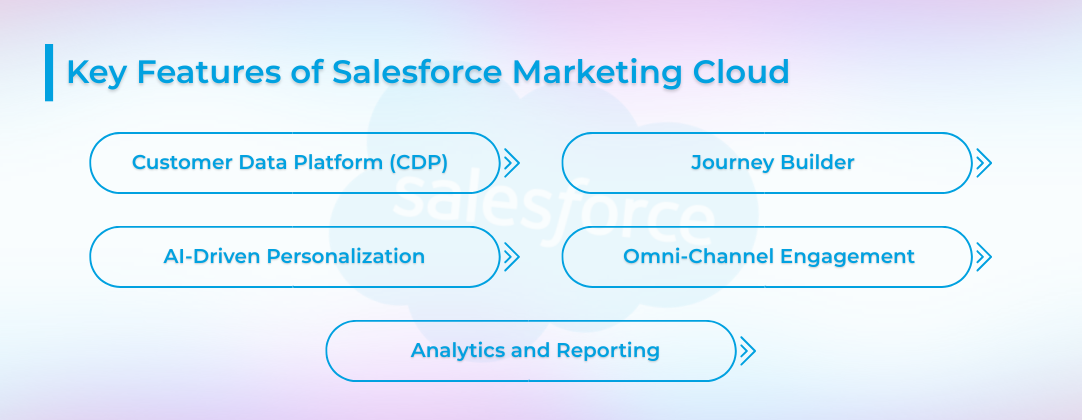
Salesforce Marketing Cloud goes far beyond traditional email marketing. It’s built to help businesses design, manage, and continuously improve end-to-end customer journeys, not just individual campaigns. Each feature plays a specific role in making marketing more relevant, timely, and conversion-focused.
Customer Data Platform (CDP)
At the foundation of Marketing Cloud is its ability to bring customer data together. The Customer Data Platform (CDP) collects and unifies first-party data - including behavioral actions, demographic details, transaction history, and stated preferences - into a single, consistent customer profile.
This unified view removes the guesswork that often comes from scattered data sources. Marketers no longer have to rely on partial insights or assumptions. Instead, they can segment audiences based on real behavior and context, which leads to more precise targeting and messaging that actually resonates.
Journey Builder
Journey Builder is where strategy turns into action. It allows teams to design automated customer journeys that respond to real-world behaviors, events, and triggers. Instead of sending messages based on fixed schedules, marketers can engage customers at the moment it matters most.
For example, a follow-up email can be triggered after a product view, a reminder can be sent when a cart is abandoned, or onboarding content can be delivered based on user activity. This approach improves timing, relevance, and consistency - all critical factors in driving higher engagement and conversions.
AI-Driven Personalization
Marketing Cloud uses built-in AI to help marketers make smarter decisions at scale. Rather than manually deciding what content to show or when to send it, AI analyzes real-time data to recommend the most effective message, channel, and timing for each individual.
This means customers don’t just receive personalized content - they receive content that’s contextually relevant to where they are in their journey. Over time, this kind of intelligent personalization builds trust, improves engagement, and increases the likelihood of conversion without adding manual effort.
Omni-Channel Engagement
Today’s customers don’t interact through a single channel, and Marketing Cloud is designed with that reality in mind. It supports engagement across email, SMS, push notifications, WhatsApp, social media, and web experiences - all managed from one platform.
What makes this powerful is consistency. No matter how or where a customer engages, the message feels connected and intentional. This seamless experience reduces friction, reinforces brand messaging, and helps guide customers smoothly from one touchpoint to the next.
Analytics and Reporting
Strong marketing decisions rely on clear insights, and Marketing Cloud provides detailed analytics to support that. Its dashboards and reporting tools offer visibility into engagement metrics, conversion performance, and revenue impact across channels and campaigns.
Marketers can quickly see what’s working, where customers are dropping off, and which campaigns are driving real value. These insights make it easier to refine strategies, adjust journeys, and focus effort on initiatives that deliver measurable results.
Top Trends Shaping Conversion Rate Optimization
Data-Driven Insights for Targeted Campaigns
Effective CRO starts with data. Without it, personalisation and optimization quickly become guesswork.
One of the most common challenges marketers face is fragmented data. When customer information lives across disconnected systems, segmentation becomes shallow, and campaigns lose relevance. Marketing Cloud’s CDP addresses this by unifying CRM data with external sources into a complete customer profile.
Once data is connected, teams can build precise segments based on real behaviour. For example
- Customers who opened multiple emails but didn’t convert
- High-value customers who’ve gone quiet
- Prospects who clicked ads but abandoned a form or cart
These insights allow marketers to align messaging with intent, which is a core principle of CRO. Campaigns become more focused, timely, and effective.
Salesforce research shows that organizations using unified data and personalization consistently achieve stronger ROI, higher engagement, and longer customer lifecycles.
Personalization Strategies for Higher Engagement
Personalization is no longer optional. Customers expect brands to recognize them, understand their needs, and communicate accordingly.
Salesforce Marketing Cloud makes personalization practical at scale. Marketers can tailor content within a single email or message, trigger communications based on user actions, and adjust offers in real time based on context.
When messages reflect a customer’s behaviour and preferences, engagement naturally improves. People are more likely to respond when content feels relevant rather than generic. Over time, this relevance builds trust - and trust drives conversions.
A/B Testing for Optimized Performance
A/B testing sits at the heart of CRO. It allows marketers to compare different versions of content, subject lines, send times, and journeys to see what performs better.
Marketing Cloud makes this process straightforward. Teams can test variations across channels, track results with confidence, and apply insights quickly. Instead of relying on assumptions, decisions are backed by measurable outcomes.
Organizations that test continuously tend to optimize faster and achieve stronger results over time. Small gains compound, and campaigns steadily improve instead of plateauing.
Multi-Channel Integration for Enhanced Reach
Customers don’t stick to one channel. They move between email, mobile, social, and web - often within the same buying journey.
Marketing Cloud’s omni-channel capabilities help marketers stay connected across those touchpoints without overwhelming the customer. Messaging stays consistent, journeys feel seamless, and engagement remains relevant.
For example, someone who interacts with an email but doesn’t convert can be followed up through SMS or retargeted through digital ads - based on behavior, not guesswork. This coordination improves reach while maintaining relevance.
Measuring Success with Advanced Analytics
“You can’t improve what you don’t measure.”
Marketing Cloud’s analytics tools help teams understand performance at every stage. From dashboards and conversion tracking to attribution models and real-time KPIs, marketers gain clarity on what’s driving results.
These insights make it easier to identify friction points, optimize underperforming campaigns, and invest in what works. Predictive analytics also allows teams to anticipate customer behavior and act before opportunities are lost.

Boosting Conversions with Salesforce Marketing Cloud
At its core, CRO is about turning insight into action. Salesforce Marketing Cloud supports that process end-to-end.
Here’s how
- Unified data fuels smarter segmentation.
- Personalization increases engagement
- A/B testing improves effectiveness
- Multi-channel orchestration expands reach.
- Analytics measure and optimize performance.
With the right strategy in place, conversions don’t happen by chance - they’re intentionally designed and consistently optimized.
Conclusion
Salesforce Marketing Cloud gives businesses a practical, scalable way to improve conversion rate optimization. By combining unified data, personalization, testing, and analytics, it helps teams create experiences that feel relevant and drive real results.
When paired with the right expertise, Marketing Cloud becomes more than a tool - it becomes a growth engine.
At TechWize, we help organizations align Salesforce solutions with real business goals, ensuring every campaign, journey, and insight contributes to measurable growth and better customer experiences.