
 501, Fifth Avenue, Suite 805 New York, NY 10017
 info@techwize.com
 +1 (949) 887-0154
 TechWize
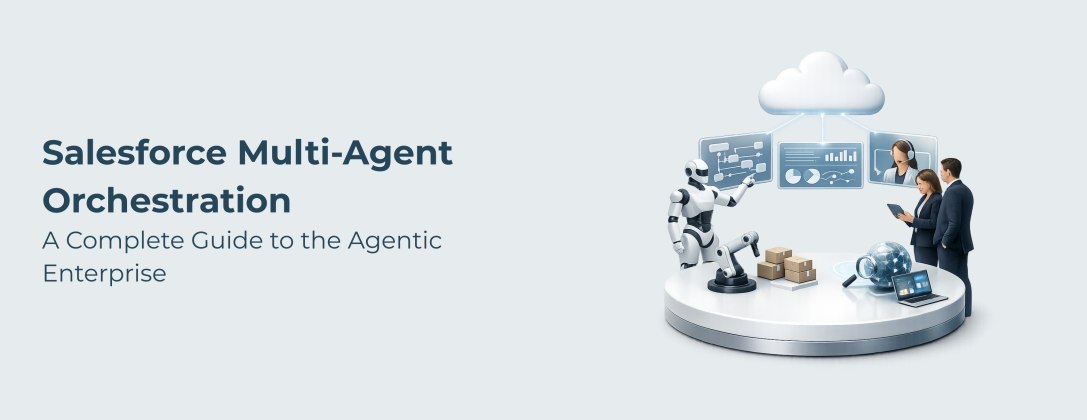
For years, businesses built AI the same way: one bot, one job. A chatbot answered support questions. A separate tool scored leads. Another handled scheduling. Each system worked in isolation, and someone always had to stitch the results together manually.
Salesforce is changing that equation. The company has been talking about the "Agentic Enterprise" for a while now, but 2026 is the year this idea stopped being a roadmap slide and started running in production. Instead of one large agent trying to do everything, or a handful of disconnected bots working in silos, Salesforce agents can now operate as a coordinated team.
This shift has a name: Multi-Agent Orchestration. It is arguably the most significant capability Salesforce has shipped inside Agentforce to date, and it changes how businesses should think about building, deploying, and managing AI going forward.
In this guide, we will break down what Multi-Agent Orchestration actually is, how it works under the hood, why Salesforce is calling it the defining feature of 2026, and what enterprises need to do to roll it out successfully.
What Is Salesforce Multi-Agent Orchestration?
In simple terms, Multi-Agent Orchestration allows multiple AI agents inside Agentforce to work together instead of operating independently.
Previously, companies had to build one large, all-purpose agent that tried to handle everything: billing questions, scheduling, product inquiries, complaints, and more. That approach worked to a point, but it created a single point of failure. If the agent got confused on one task, it could affect the entire conversation.
Now, businesses can build smaller, focused agents where each one owns a specific job. A dedicated "orchestrator" agent decides which specialist agent should respond to a given request. The person on the other end of the conversation never sees this handoff. They experience one continuous chat window, regardless of whether the conversation moves across channels like web chat, email, or WhatsApp.
This is a meaningful departure from how Salesforce Agentforce used to function, where each agent ran on its own with little to no awareness of what other agents were doing. There is also a practical reason enterprises prefer this model: smaller, focused agents are easier to test, easier to fix, and easier to hand over to different teams for ongoing management. When everything lives inside one massive agent, a small error in one area can ripple across the entire system.
How Multi-Agent Orchestration Works Inside Salesforce Agentforce
Understanding the mechanics of orchestration matters, especially for teams planning a Salesforce implementation around Agentforce.
The Orchestrator and Subagents
One agent is designated as the main controller, known as the orchestrator. Inside Agentforce Builder, an admin or developer connects other agents to it as subagents. Each subagent includes a clear description of what job it performs and when it should step in. This description is not just documentation; it is functionally how the system decides which agent to route a task to.
Agent Router and Cross-Platform Communication
Through Agent Router, subagents are added under reasoning actions so the orchestrator can call them directly when needed. Salesforce has also introduced support for the Agent2Agent (A2A) protocol, which allows Agentforce agents to communicate with agents built on entirely different platforms. This means a Salesforce orchestrator is not limited to working only with Salesforce-native agents; it can extend its reach across an organization's broader technology stack.
This kind of cross-system coordination is also where dedicated AI Development becomes valuable, particularly for enterprises that need custom logic connecting orchestrated agents to systems outside the core Salesforce environment.
Why Salesforce Launched the Biggest Feature of 2026
Salesforce has shared numbers that back up why it considers this its flagship release for the year. Agentforce's annual revenue reportedly reached 800 million dollars, growing 169 percent year-over-year, while total AI revenue crossed 2.9 billion dollars (source: Salesforce). The company also closed 29,000 Agentforce deals over the past year and recorded 2.4 billion agent-driven work units across Agentforce and Slack combined (source: Salesforce).
What makes Multi-Agent Orchestration different from previous updates is that it changes the fundamental question businesses ask. Before, the question was: "Do we have an agent for this task?" Now it is: "How do we get multiple agents to work together across departments?"
Agents built for different functions can now hand off work to one another, pull information from connected tools such as Tableau through the new Tableau MCP connection, and combine everything into a single, coherent answer, all without human intervention. This kind of multi-step, cross-department coordination simply was not possible when every agent operated in isolation.
This matters because most large organizations do not run on a single department. Sales, service, finance, and IT all operate their own systems, their own data, and their own workflows. A single agent designed for one team rarely fits the needs of another. Orchestration solves this by letting each department keep its own specialized agent while still delivering one seamless experience to the customer or employee on the front end.
Salesforce Agentforce Services That Strengthen Multi-Agent Orchestration
Orchestration does not operate in a vacuum. Several supporting capabilities released alongside it make the entire system more reliable and easier to manage.
Refined Agent Analytics brings Service Agent and Employee Agent data together into a single dashboard with more than 40 metrics, giving teams visibility into how their agents and workflows are actually performing.
Custom Scorers, still in beta, let teams evaluate agent conversations against their own goals, including tone, customer sentiment, product interest, escalation triggers, and politeness, alongside Salesforce's standard quality checks.
MCP Integration is now built directly into Agentforce, allowing agents to connect to outside tools and systems without requiring a custom integration for each one. An admin can configure an MCP server once, and agents can discover and use its capabilities independently.
Flow Orchestration, now free for all Salesforce users, helps teams manage multi-step workflows involving agents, people, and outside systems through a no-code interface that pairs naturally with agent-level orchestration.
Underneath all of this sits data. For agents to hand off work accurately, they need to be working from the same customer information. This is where a properly structured Salesforce Data Cloud Implementation becomes essential, ensuring every agent, regardless of department, is reasoning from a single, unified source of truth.
Business Benefits of Salesforce Multi-Agent Orchestration
The shift to orchestrated agents delivers measurable operational value.
Faster resolution through coordinated handoffs. When agents can pass context to one another instantly, customers no longer repeat themselves across channels, and issues get resolved in fewer steps.
Reduced errors from clear agent descriptions and routing. Since routing depends entirely on how well an agent's role is defined, well-documented agents reduce the chances of a request landing with the wrong specialist.
Scalable automation across sales, service, and marketing. Departments can add new specialized agents as needs grow, without having to rebuild or retrain one giant, do-it-all system. Sales teams benefit particularly here, where Sales Cloud (Agentforce Sales) capabilities allow pipeline and outreach agents to work directly alongside service and marketing agents rather than in isolation.

Ready to Build Your Agentic Enterprise?
Multi-Agent Orchestration is reshaping how businesses run Agentforce, but a successful rollout depends on clean data, clear agent design, and the right implementation partner. TechWize helps enterprises plan, build, and scale orchestrated agent systems the right way.
Talk to Our Salesforce ExpertsSalesforce Consulting Services for a Smooth Multi-Agent Orchestration Rollout
Multi-Agent Orchestration is powerful, but it is not something to switch on without preparation. Since routing depends completely on how clearly an agent's description is written, a vague or poorly structured description leads to misrouted conversations and inconsistent customer experiences.
Salesforce implementation experts consistently point to the same lesson: companies should invest real time in writing clear agent descriptions and cleaning up CRM data before adding more agents into a live environment. Rushing this step, even when the underlying technology works fine, tends to produce messy, unpredictable results.
A safer path looks like this: pick one well-defined, high-impact task first, get the data and agent descriptions right, and only then introduce additional specialist agents, one at a time. This is precisely the kind of structured rollout that experienced Salesforce Consulting Services are built to support, helping enterprises avoid the common pitfalls that come with scaling too quickly. Marketing teams following this same phased approach often extend orchestration into Marketing Cloud, allowing campaign and engagement agents to coordinate with sales and service agents without disrupting existing workflows.
How TechWize Helps Enterprises with Salesforce Multi-Agent Orchestration Implementation
Rolling out Multi-Agent Orchestration successfully requires more than enabling a feature. It requires the right data foundation, clearly scoped agent architecture, and ongoing governance, which is exactly where TechWize supports enterprises across the full journey.
TechWize helps businesses:
- Assess organizational readiness for Agentforce and Multi-Agent Orchestration through structured Salesforce Consulting Services
- Build a unified, real-time data foundation so agents share consistent context across departments
- Design and deploy orchestrated agent architectures tailored to specific business functions, including Sales Cloud (Agentforce Sales) and Marketing Cloud environments
- Connect Salesforce with external tools and systems, including custom AI Development for use cases that extend beyond native Agentforce capabilities
- Explore emerging integrations such as Sage AI, where finance and operational workflows intersect with agent-driven automation
- Provide ongoing monitoring, agent performance tracking, and governance support after go-live
Rather than treating orchestration as a one-time technical switch, TechWize approaches it the way Salesforce itself recommends: start with one well-defined use case, validate it thoroughly, and expand with discipline. If your organization is evaluating Agentforce or planning to move from standalone bots toward a coordinated agent model, TechWize's Salesforce team can help map out a rollout plan built around your existing systems and data.
Read Similar Blog
Building Multi-Agent Workflows in Salesforce and ServiceNow: A Strategic Guide
Explore More Insights ⬩➤Conclusion: Reinforcing Multi-Agent Orchestration as the Defining Salesforce Feature of 2026
Salesforce Multi-Agent Orchestration marks a genuine turning point, not just an incremental update. It moves organizations away from disconnected, single-purpose bots and toward coordinated teams of specialist agents that share context, hand off work seamlessly, and operate across departmental boundaries without losing the simplicity of a single conversation for the end user.
The technology behind it, from the orchestrator and subagent model to the Agent2Agent protocol and native MCP integration, gives enterprises a genuinely new way to structure AI across sales, service, marketing, and finance. But as with any powerful capability, success depends less on the technology itself and more on how thoughtfully it is implemented: clean data, clear agent descriptions, and a phased rollout.
Enterprises that get this right will not just automate more tasks. They will operate as a genuinely agentic organization, where AI agents work together the way well-run human teams do. For businesses ready to make that shift, understanding orchestration is the first step, and getting the implementation right is where the real value gets unlocked.