
 501, Fifth Avenue, Suite 805 New York, NY 10017
 info@techwize.com
 +1 (949) 887-0154
 TechWize
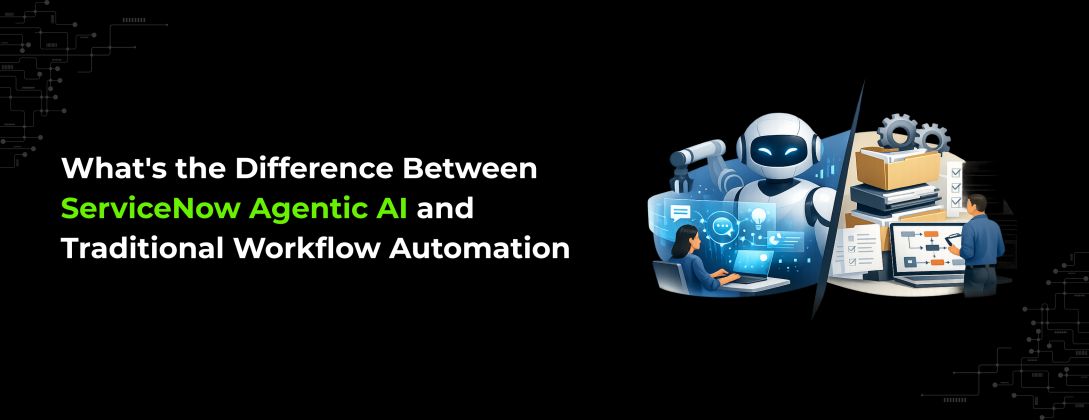
Picture an incident that starts in IT, needs a security sign-off, and finally lands on an HR desk before it is resolved. In most enterprises, that single ticket bounces between four or five people, each one waiting on the last, while the SLA clock keeps running. This is where static, rule-based automation reaches its limit.
ServiceNow Agentic AI changes that equation. Instead of following a fixed script, autonomous agents built on ServiceNow Enterprise AI Agents' automation capabilities interpret intent, pull context from across the platform, and decide the next best action on their own. ServiceNow AI Automation is no longer just about moving a ticket faster - it is about removing the need for a human to move it at all.
This blog breaks down how ServiceNow Agentic AI is different from traditional workflow automation, where each approach fits, and how enterprises can move from static rules to autonomous, goal-driven operations in 2026.
Traditional Workflow Automation vs ServiceNow Agentic AI Automation: Where It Starts
Traditional workflow automation runs on "if-this-then-that" logic. A password reset triggers a script. An approval request routes to a manager. It is dependable for repetitive, well-defined tasks. Still, it has no memory of past incidents, no ability to learn, and it breaks the moment a scenario falls outside its programmed rules.
ServiceNow AI Automation takes a fundamentally different approach. Agents are assigned a goal - such as resolving an incident or completing an onboarding request - rather than a fixed sequence of steps. They evaluate real-time data, historical outcomes, and system context, then choose the path most likely to achieve that goal. Where traditional automation asks "what rule applies here," agentic systems ask "what outcome are we trying to reach, and how do we get there?"
This is not a minor upgrade. It is a shift from automation that executes instructions to automation that makes decisions.
Why ServiceNow Agentic AI Matters for Enterprise Decision-Makers
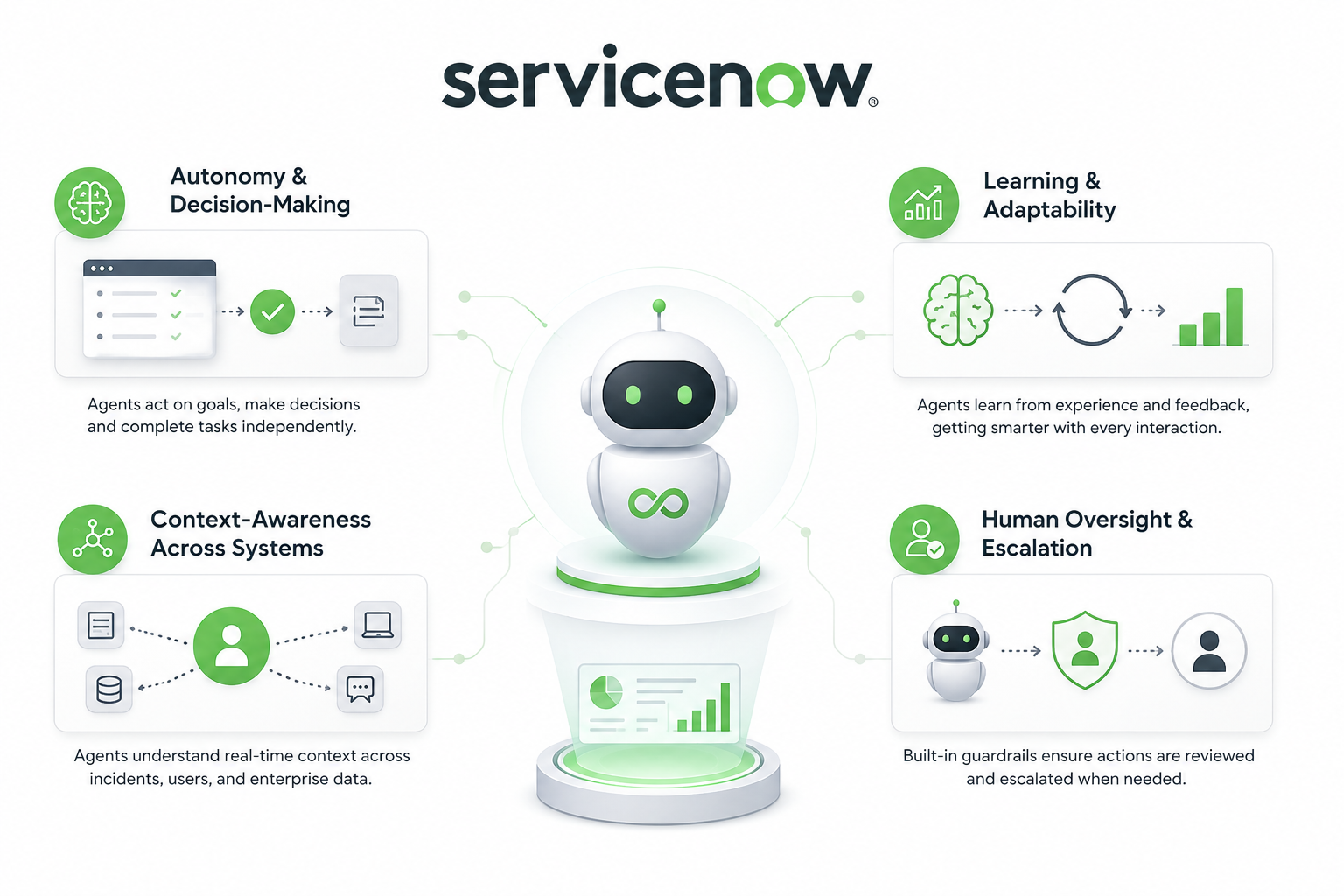
For CIOs and IT leaders evaluating where to invest next, the value of ServiceNow Agentic AI comes down to four practical capabilities that traditional automation cannot offer.
Autonomy and Decision-Making in ServiceNow Agentic AI
Agents built through AI Agent Studio are given specialties and goals rather than scripted steps. An agent tasked with optimizing cloud spend, for example, can query the CMDB for underused assets, cross-check active contracts, and raise a change request - without waiting for someone to initiate each step manually.
Learning and Adaptability Over Time
Traditional automation is frozen after deployment. ServiceNow Agentic AI keeps learning. Agents refine their actions using historical patterns and feedback loops, so the tenth time an issue occurs, resolution is faster and more accurate than the first.
Context-Awareness Across Enterprise Systems
Agents operate with real-time context drawn from incidents, users, and prior actions across the platform. Instead of treating every request as an isolated event, agents connect the dots - recognizing, for instance, that a user's travel booking should automatically trigger a corporate card update.
Human Oversight and Escalation Paths in AI Agent Workflows
Autonomy does not mean unchecked authority. Enterprises define thresholds, and any action above a financial or operational limit pauses for human approval before execution. This keeps agentic speed without giving up control.
Governance and Security Controls for ServiceNow Agentic AI Deployments
Autonomy raises a fair question: who is accountable when an agent acts on its own? ServiceNow addresses this through built-in governance rather than bolted-on oversight.
The AI Control Tower gives administrators a live view of every active agent and a full reasoning log so that any decision can be traced back to the data and logic behind it. This matters enormously for regulated industries that need an auditable trail of AI-driven activity.
Security is enforced the same way it is for human users. Agents operate within role-based access controls, so a benefits agent cannot read security logs and a service desk agent cannot touch payroll data. Built-in filters also guard against prompt injection attempts designed to manipulate an agent into bypassing its own guardrails. Together, these controls are what allow enterprises to scale agentic AI without losing sight of who did what, and why.
When Should Enterprises Choose Agentic AI Over Traditional Automation?
Not every process needs an autonomous agent. Traditional automation is still the right call for stable, predictable tasks such as password resets or standard approval routing. Agentic AI earns its place when the situation involves genuine complexity or ambiguity.
The comparison below summarizes where each approach fits best.
| Factor | Traditional Automation | ServiceNow Agentic AI |
|---|---|---|
| Decision-making | Predefined rules only | Context-aware, goal-driven |
| Learning | None after deployment | Continuous, feedback-based |
| Human Dependency | High, constant oversight needed | Reduced, exception-based oversight |
| Best Fit | Repetitive, structured tasks | Complex, cross-system, exception-heavy processes |
| Scalability | Manual effort to extend | Adaptive across departments |
As a general rule, enterprises should reach for agentic AI when a process spans multiple systems or departments, when personalization improves the outcome, or when speed of resolution directly affects customer or employee experience. For everything else, traditional automation remains a reliable, lower-cost option.
How to Implement ServiceNow AI Agents: A Simple Step-by-Step Guide
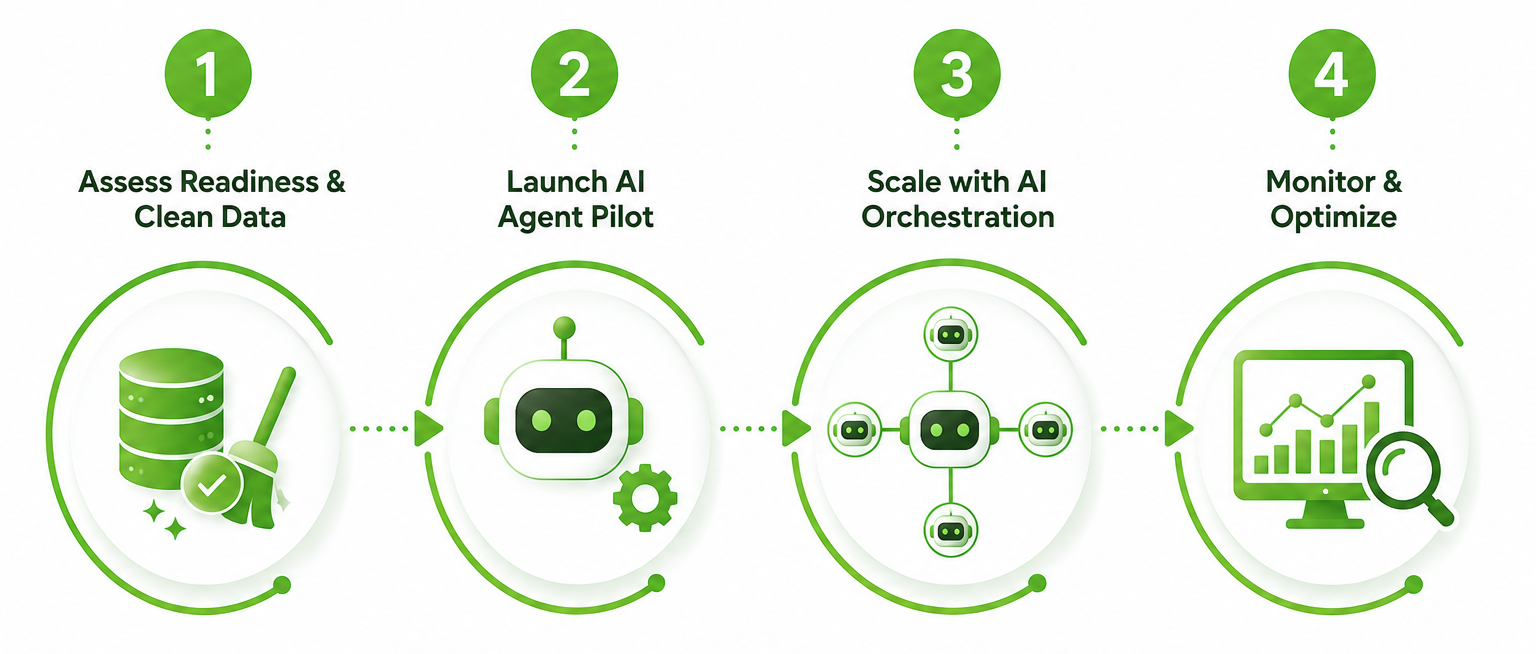
Moving to ServiceNow Agentic AI works best as a phased rollout rather than an all-at-once switch. Enterprises that skip steps or rush straight to enterprise-wide deployment tend to run into the same problem: agents making decisions on data or processes that were never ready for autonomy in the first place. The four phases below outline what a realistic, end-to-end implementation actually looks like, from the first data audit to full-scale orchestration.
Assess Readiness and Clean Up Your Data:
Agent decisions are only as good as the data behind them, so this phase is less about technology and more about groundwork. Start with a full audit of key ServiceNow tables, including the CMDB, CSDM, and historical incident records, to identify gaps, duplicates, and outdated records that could mislead an agent's reasoning. In parallel, map your current workflows to understand where decisions are made manually today and why. This is also the stage to pick one or two high-value use cases with a clear, measurable outcome, such as reducing average incident resolution time or cutting the volume of routine HR tickets. This makes the business case easier to defend later. Expect this phase to take four to six weeks for a typical mid-sized ServiceNow instance and longer if data governance has been inconsistent.
Run a Pilot with One or Two Agents:
Once the foundation is solid, build a small number of agents in AI Agent Studio, scoped tightly around high-volume, low-risk processes such as password resets, routine approval routing, or common HR queries. Define the agent's specialty, the tools and data sources it can access, and clear instructional guardrails before it ever touches a live workflow. Run the pilot alongside existing manual processes rather than replacing them outright, so you have a direct baseline for comparison. Monitor every decision the agent makes, track resolution times against the pre-agent baseline, and gather structured feedback from the frontline teams working alongside it. A pilot typically runs for six to eight weeks, long enough to surface edge cases without dragging the evaluation out.
Scale Across the Enterprise with Orchestration:
Once the pilot proves out and stakeholders sign off on the results, expand agent coverage to additional use cases and departments. This is where the AI agent orchestrator becomes essential, since coordinating five or ten agents manually quickly becomes unmanageable. The Orchestrator manages task handoffs, sequencing, and dependencies between agents, so a SecOps agent clears access before a Workplace agent assigns a resource, for example. Connect this expansion to the AI control tower from day one so every agent's reasoning log and decision trail is centrally visible, not scattered across individual teams. Budget real time for change management here. Teams need to understand when an agent will act, when it will escalate to a human, and how to raise concerns if something looks wrong.
Monitor, Learn and Optimize Continuously:
Treat this as an ongoing program rather than a one-time project, because agent performance is not static. Set a regular review cadence, monthly is common, to check decision accuracy, escalation rates, and cost impact against the goals set in phase one. Use that data to refine agent instructions, tighten or loosen guardrails, and retire agents that are not delivering value. As confidence builds, extend agent capabilities into more complex, cross-department scenarios, and revisit your governance framework periodically to make sure it still matches your risk profile as autonomy grows.
Real-World Applications of ServiceNow AI Agent Services Across the Enterprise
ServiceNow AI Agent Services are already active across the major service domains, each with a distinct operational impact.
ServiceNow AI Agent Services in IT Operations - Autonomous Triage and Predictive Remediation
When a network anomaly appears, an agent correlates it with recent changes, runs diagnostics, and checks dependencies through the CMDB before a human is even looped in. This overlaps closely with ServiceNow IT Operations Management (ITOM), where predictive remediation and self-healing actions reduce the time an issue sits unresolved. Enterprises extending this further into asset visibility often pair it with IT Asset Management (ITAM) to keep the underlying inventory data accurate enough for agents to trust.
ServiceNow AI Agent Services in HR Service Delivery - Proactive Employee Lifecycle Management
HR shifts from a ticket-based function to an outcome-based one. An agent can notice an employee approaching a service milestone and coordinate a reward, update payroll, and queue a career recommendation, all without a request being filed. This is a natural extension of ServiceNow HRSD Solutions, where proactive, milestone-driven service delivery replaces reactive case handling.
ServiceNow AI Agent Services in Customer Service Management - End-to-End Resolution
A customer reporting a faulty product no longer waits in a queue. The agent verifies warranty status, checks inventory, schedules a return, and triggers a replacement, often resolved in a single interaction. Many of these hand-offs still run through core ServiceNow IT Service Management Solutions underneath, which is why clean ITSM data remains the foundation agents rely on for accurate decisions.
Industry Applications - Banking, Financial Services and Telecom
In banking, agents strengthen SLA and risk management through integrated GRC and autonomous fraud-related case handling. In telecom, agents handle predictive maintenance and proactive billing resolution before a customer notices a problem.

Ready to Move Beyond Static Workflow Automation?
Traditional automation can only take your enterprise so far. TechWize helps you design, deploy, and govern ServiceNow Agentic AI so your teams resolve issues faster, cut manual effort, and scale with confidence. Let's build your roadmap together.
Talk to a ServiceNow AI ExpertCost Savings, Faster Resolutions and ROI from ServiceNow AI Agent Implementation
The business case for ServiceNow Agentic AI is measurable. ServiceNow's own data shows AI agent integration led to a 52 percent reduction in time required to handle complex customer service cases (source: ServiceNow, via Warmly AI Agents Statistics 2026). More broadly, Gartner projects that 40 percent of enterprise applications will include embedded, task-specific AI agents by the end of 2026, up from under 5 percent in 2024 (source: Gartner).
Beyond raw speed, the financial impact compounds. Faster resolution reduces SLA breach penalties, frees skilled staff from repetitive coordination work, and lowers the operational cost of running exception-heavy processes manually. ServiceNow's Enterprise AI Maturity Index also found that 43 percent of organizations are actively considering agentic AI adoption in 2026 (source: ServiceNow Enterprise AI Maturity Index), signaling that this is quickly becoming a competitive baseline rather than an early-adopter advantage.
Hire TechWize for ServiceNow AI Agent Implementation Solutions
Choosing the right platform capability is only half the equation. Getting ServiceNow Agentic AI configured, governed, and adopted correctly is where most enterprises need an experienced partner.
TechWize brings certified ServiceNow expertise across AI Agent Studio configuration, orchestration design, and governance frameworks built to match your industry's risk profile. Our team has delivered ServiceNow AI agent implementation solutions across IT, HR, and customer service functions, helping enterprises move from a stalled pilot to a production-ready deployment without the guesswork.
Whether you are assessing readiness, running your first pilot, or scaling agents across departments, TechWize's ServiceNow AI Agent Services are built to get you there faster and with the right controls in place from day one. Hire TechWize to turn your Agentic AI roadmap into a working, governed reality.
Read Similar Blog
AI-Powered ServiceNow Implementation – The Next Evolution of IT Service Delivery
Explore More Dynamics 365 Insights ⬩➤Conclusion: The Future of ServiceNow Agentic AI Is Autonomous, Yet Governed
Traditional automation is not going away, and it should not. It remains the right tool for stable, repetitive tasks. But for the complex, cross-departmental, exception-heavy work that consumes most of an enterprise's operational drag, ServiceNow Agentic AI offers something rule-based systems never could: the ability to reason, adapt, and act toward a goal while staying fully accountable.
The enterprises pulling ahead in 2026 are not the ones with the most agents. They are the ones building the governance, data readiness, and orchestration foundations now, so that autonomy scales without losing control. That is the real difference between ServiceNow Agentic AI and traditional workflow automation - and it is the direction the entire platform is heading.