
 501, Fifth Avenue, Suite 805 New York, NY 10017
 info@techwize.com
 +1 (949) 887-0154
 TechWize
Here's the honest version of what most RevOps teams deal with every day. Sales quotes something in one tool. Finance bills it in another. And somewhere in between, a contract gets signed that does not quite match either one. Nobody planned this mess on purpose; it just happens when quoting, billing, and contracts grow up in separate systems.
Salesforce Agentforce Revenue Management Cloud is built to close that gap. It is Salesforce's AI-driven revenue platform that runs configuration, pricing, quoting, contracts, orders, and billing on one native data model rather than a patchwork of disconnected tools. Announced at Dreamforce 2025 alongside Agentforce 360, it drives predictable growth through agentic quoting, agentic billing, and consumption management (source: Salesforce). So instead of stitching systems together after the fact, the AI agents development inside a single source of truth from day one.
And honestly, this is the part that gets buried under all the AI hype. The real unlock is not the chatbot layer. It is that pricing, contracts, and billing finally live in one place.
How Salesforce Agentforce Revenue Management Cloud Works
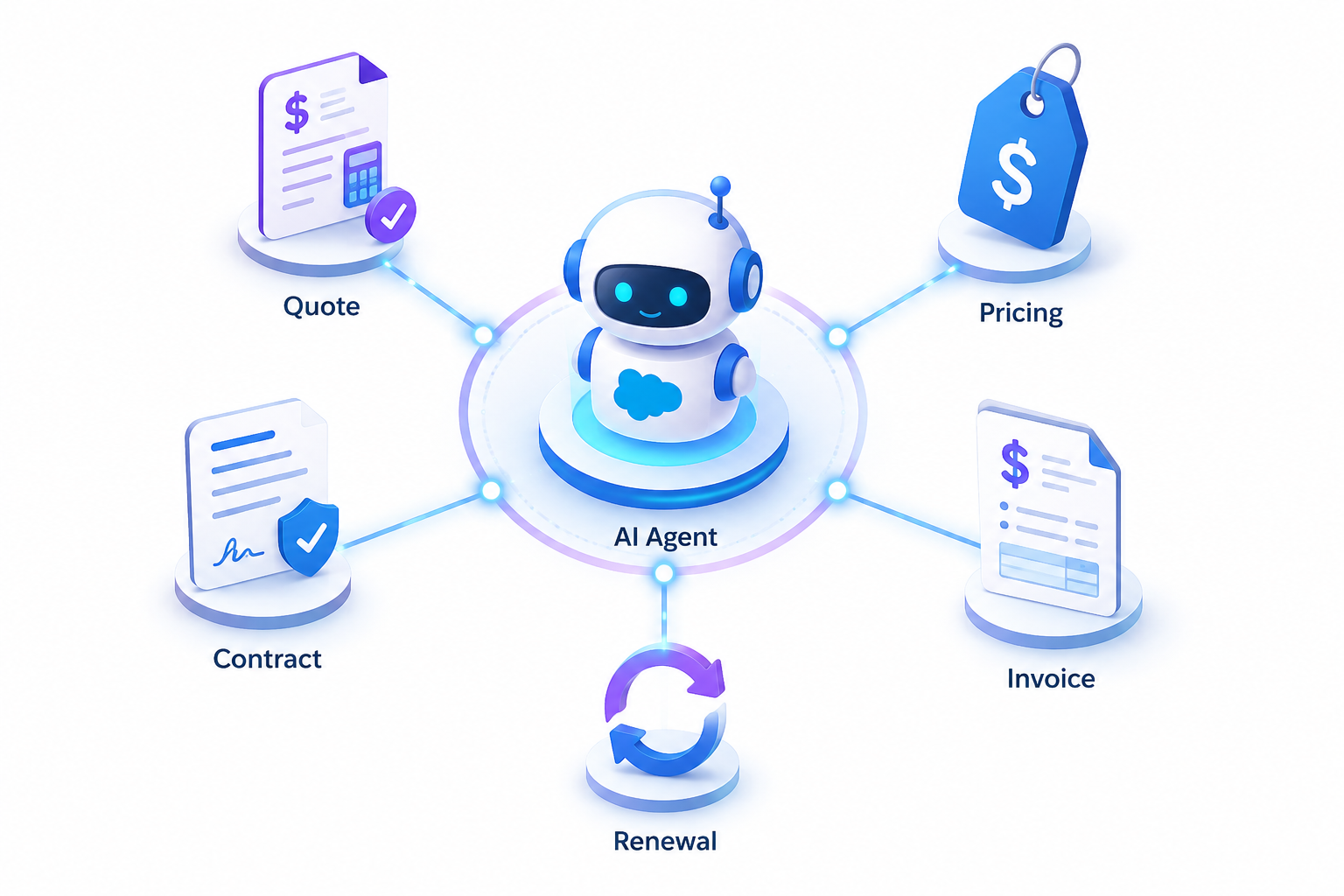
Salesforce Agentforce Revenue Management Cloud runs the entire quote-to-cash process on native Salesforce Platform objects, rather than a bolt-on managed package on top of the CRM. That single change is what enables AI agents to reason across pricing, contracts, and usage data simultaneously.
Legacy CPQ, which began life as SteelBrick before Salesforce acquired it in 2015, stored its data in a separate object model layered on top of core Salesforce records. It worked fine for a decade. But it also meant that an AI agent trying to review a quote, a contract, and an asset record had to hop across systems to do so, and that friction adds up fast at scale.
Agentforce Revenue Management removes that hop entirely. Product catalog, pricing procedures, contracts, and billing all sit on the same platform as Sales Cloud and Service Cloud. Data Cloud feeds context in, Agentforce agents act on it, and the result is a system where a renewal recommendation or an approval decision is based on the full picture, not a partial one pulled from three different tools.
Emerging Trends in AI-Powered Revenue Management Cloud
AI-powered revenue management is trending toward agents that not only recommend actions but also take them, within the guardrails a business sets in advance. Think auto-approving a low-risk quote, or flagging a renewal three months before a human would have noticed the account was drifting.
This shift is happening because the underlying business reality has changed. The global subscription economy grew 11.4 percent in the twelve months ending Q4 2025, comfortably outpacing broader economic growth (source: Zuora 2026 Subscription Economy Index). And B2B subscriptions alone now make up more than 55 percent of total subscription economy revenue (source: Zuora Subscription Economy Index). That is a lot of recurring, usage-based, and hybrid pricing that a static rules engine was never built to handle cleanly.
At the same time, Salesforce has been public about where its own growth expectations are pointed. The company guided organic sales growth above 10 percent year over year for 2026, with Agentforce cited as a core driver (source: Fortune). So this is not a side project for Salesforce Services. It is becoming the backbone of how the company expects revenue teams to operate going forward, and that momentum tends to pull the rest of the market with it.
10 Must-Have Features of Agentforce Revenue Management Cloud (2026)
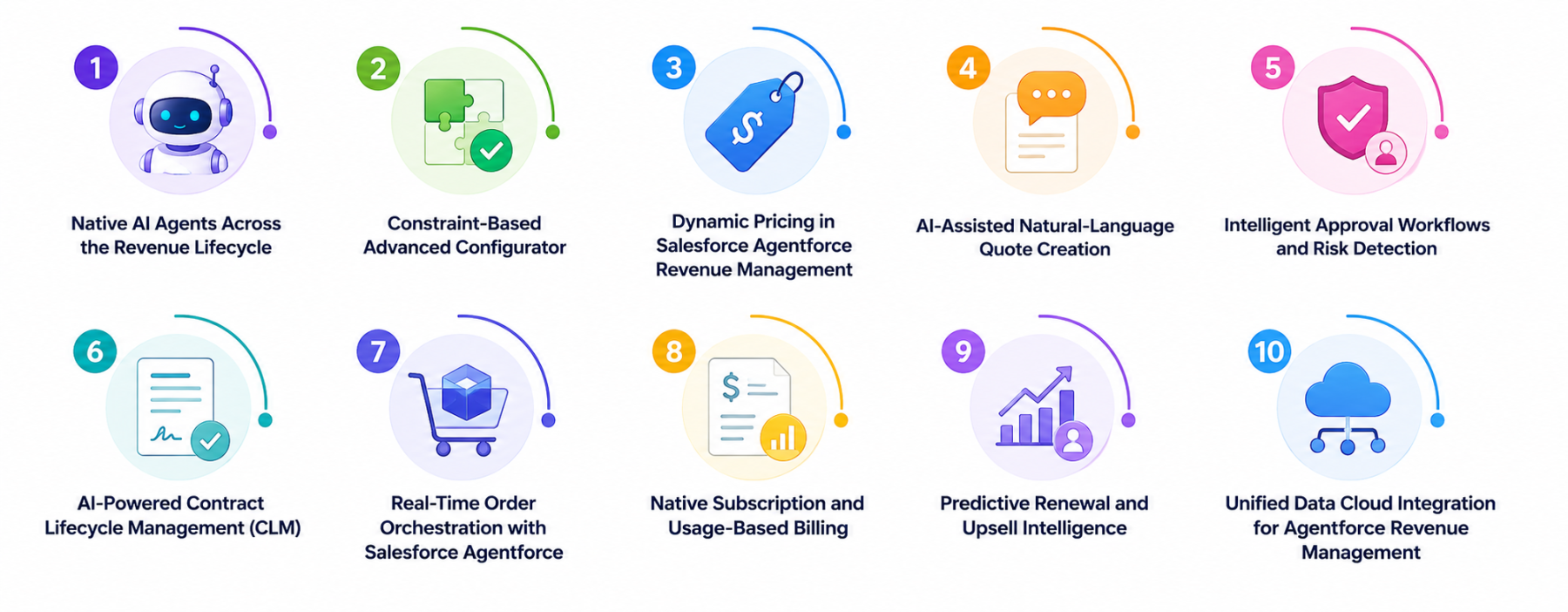
This is the part worth bookmarking. These ten capabilities are what actually separate Agentforce Revenue Management from a standard CPQ tool with an AI label slapped on top.
1. Native AI Agents Across the Revenue Lifecycle
Native AI agents sit inside every stage of the revenue process, not just the quoting step. Salesforce built agentic quoting, agentic billing, and consumption management directly into the platform at Dreamforce 2025 (source: Salesforce), so agents can act on pricing, approvals, and renewals using the same live data a human rep would see. That is a real shift from the old Einstein add-on model, where AI felt like a feature you turned on rather than something baked into the workflow itself.
2. Constraint-Based Advanced Configurator
The Advanced Configurator replaces CPQ's older rule-based engine with constraint-based logic for complex product bundles. Instead of an admin writing endless if-this-then-that rules that eventually collapse under their own weight, the configurator dynamically validates combinations. For businesses selling multi-part, highly configurable products, this alone cuts down a huge chunk of ongoing admin overhead.
3. Dynamic Pricing in Salesforce Agentforce Revenue Management
Dynamic pricing procedures support one-time, subscription, and usage-based pricing inside a single quote. That matters more than it sounds like on paper, because most modern deals are not purely one pricing type anymore. A single enterprise contract might have a flat platform fee, a per-seat subscription line, and a consumption-based overage clause. Static price books were never built to hold all three cleanly, and dynamic pricing procedures are Salesforce's direct answer to that.
4. AI-Assisted Natural-Language Quote Creation
Reps can generate a quote by describing what they need in plain language, and Agentforce automatically builds the line items, formatting, and summary. This is one of those features that sounds like a small convenience until you watch a rep who used to spend forty minutes building a multi-line quote do it in under five. The time saved compounds fast across a sales team of any real size.
5. Intelligent Approval Workflows and Risk Detection
AI-assisted approval workflows flag unusual discounting or pricing risk before a quote even reaches a human approver. Low-risk quotes route through faster, while genuinely risky ones get surfaced with context attached. Here is the thing nobody mentions about approval bottlenecks, though: they rarely come from bad intent. They come from managers not having enough context to approve quickly, and that is exactly the gap this feature closes.
6. AI-Powered Contract Lifecycle Management (CLM)
Native contract lifecycle management generates AI summaries and clause recommendations and surfaces renewal triggers automatically, rather than relying on someone to remember to check a spreadsheet. Legal and sales reviews move faster because the contract data is already connected to the quote and pricing data it came from, so there is nothing to reconcile manually.
7. Real-Time Order Orchestration with Salesforce Agentforce
Real-time order orchestration replaces the older, more batch-style order processing common in legacy CPQ setups. Orders move from quote to fulfillment without the manual handoffs that once slowed communication between sales, operations, and finance. For companies running high order volumes, this is where a lot of quiet operational drag used to live.
8. Native Subscription and Usage-Based Billing
Native billing for subscriptions and consumption models means many businesses no longer need a separate Salesforce Billing package or a third-party billing tool bolted on. Given that B2B subscriptions already represent well over half of total subscription economy revenue (source: Zuora Subscription Economy Index), having billing live natively inside the same platform as quoting and contracts is not a nice-to-have; it is closer to table stakes.
9. Predictive Renewal and Upsell Intelligence
Predictive renewal intelligence flags at-risk accounts and surfaces upsell or cross-sell opportunities ahead of the renewal date, instead of waiting for a rep to notice usage dropping off. This is genuinely one of the more underrated features on this list. Most churn is visible in the data months before it shows up in a renewal conversation, and this feature is built specifically to catch that early signal.
10. Unified Data Cloud Integration for Agentforce Revenue Management
Data Cloud integration gives AI agents a single, unified view of pricing, contract, asset, and usage data instead of a fragmented one. Every other feature on this list depends on this one working well underneath it. Without unified data, an AI agent is just guessing with partial information, and that is where a lot of earlier CPQ-plus-AI attempts quietly fell short.
Key Benefits of Salesforce Agentforce Revenue Management Cloud
The benefits mostly come down to speed and trust in the data. Quotes get built faster because reps are not fighting a rules engine. Approvals move more quickly because risk is flagged automatically rather than discovered late. Finance teams get billing and revenue data that already matches what sales quoted, so month-end reconciliation stops being a fire drill.
There is also a quieter benefit that matters more over time than any single feature does. When pricing, contracts, and billing all sit on a single data model, every future AI investment a company makes in revenue operations compounds on that foundation rather than fighting fragmented systems. That is genuinely hard to put a number on, but anyone who has tried to bolt AI onto a messy data layer knows exactly what problem this solves.
Industry Use Cases of Salesforce Agentforce Revenue Management Cloud
SaaS and subscription businesses get the most immediate value, since hybrid pricing and usage billing sit right at the center of what this platform was built for. Manufacturers selling complex, multi-part configured products benefit from the constraint-based configurator cutting down rule maintenance. Telecom and consumption-heavy businesses lean on native usage billing to avoid a separate metering tool entirely.
Professional services firms with milestone-based contracts benefit from the tighter link between contracts and billing. And service-heavy organizations running Field Service alongside their revenue operations get cleaner handoffs between a signed contract, an installed asset, and the ongoing billing tied to it, since all three now live in a single data model rather than in three disconnected systems.
Salesforce Agentforce Integration: Driving AI-Powered Revenue Automation
Salesforce Agentforce Integration connects revenue management to the rest of a company's Salesforce ecosystem, ensuring agents are not working from a narrow slice of data. When Agentforce Revenue Management is connected to Sales Cloud (Agentforce Sales), reps get pricing and quoting recommendations built on the same account history and pipeline data they already work from daily.
The same logic extends outward. Tying revenue data back to Marketing Cloud means renewal and upsell signals can automatically trigger targeted campaigns, rather than sitting in a report nobody opens until the quarter is almost over. This is really the whole point of Agentforce Integration as a concept: it is not one product talking to another; it is one data model powering decisions everywhere across the business.

Not Sure Which Agentforce Revenue Management Features Fit Your Business?
Every revenue setup looks different once you dig into pricing models, contracts, and billing history. Talk to TechWize about which of these features matter most for where your business stands today, and what a realistic migration path could look like.
Talk to Our Agentforce TeamHow Agentforce Revenue Management Cloud Delivers Long-Term in 2026
The long-term payoff is less about any single feature and more about what happens when a company stops rebuilding the same integration work every year. Native architecture means fewer middleware connections between quoting, billing, and contract tools, which means fewer things breaking silently during a routine update.
It also means the AI investment a company makes today keeps paying off later, because the data foundation does not need to be re-architected every time a new agent capability ships. Given that Salesforce has guided organic growth above 10 percent year over year for 2026, with Agentforce as a stated driver (source: Fortune), it is a reasonably safe bet that ongoing feature investment will keep landing here, not on the legacy CPQ side.
TechWize: Your Salesforce Agentforce Services Provider
Getting Agentforce Revenue Management right is less about flipping a switch and more about setting up the underlying data, catalog, and pricing logic properly from the start. That is where a team that has actually done this work before makes a real difference. TechWize works with businesses on Salesforce Agentforce Services, from evaluating whether a migration makes sense right now to handling the catalog rebuild, pricing procedure setup, and Agentforce integration work that ties it all together. If your team is weighing a move off legacy CPQ or just wants a second opinion before committing budget, that is a conversation worth having early rather than mid-project.
Read Similar Blog
The Complete Salesforce Agentforce Multi-Agent Orchestration Guide
Explore More Salesforce Insights ⬩➤Conclusion: Drive Revenue Success with Agentforce Revenue Management Cloud
None of this means every business needs to migrate tomorrow. Legacy CPQ still works, and Salesforce has made it clear that existing customers retain support and renewal rights. But the direction is not really in question anymore. The investment, the AI capability, and the architecture built for where recurring and usage-based revenue is headed all now sit on the Agentforce Revenue Management side. The businesses that start evaluating this early, even just through a pilot on one product line or business unit, are the ones that will not be scrambling to catch up when the rest of the market has already moved.