
 501, Fifth Avenue, Suite 805 New York, NY 10017
 info@techwize.com
 +1 (949) 887-0154
 TechWize
If you've spent any time around a Saudi hospital in the last few years, you've probably noticed something. The paper folders are gone. The long queues at the reception desk are shorter. People are booking appointments from their phones instead of standing in line at 7 AM.
That's not an accident. It's Vision 2030 doing what it set out to do. Over 31 million users now benefit from the Sehhaty app. At the same time, the Seha Virtual Hospital has expanded to serve more than 365,000 beneficiaries through a network of 241 connected healthcare facilities (source: Saudi Press Agency, Health Sector Transformation Report 2025). That's not a small pilot project. That's basically the whole country logging into a health app.
And here's the thing nobody really says out loud: none of this happens without software. Behind every app, every virtual consultation, every insurance claim that gets approved in seconds instead of weeks, there's a team of developers who built the system that makes it work. Healthcare Software Development has quietly become one of the most important and most in-demand corners of the Saudi tech industry.
This guide walks through what's actually being built, what regulators expect, what it costs, and where the market is headed. No fluff, just what hospital administrators, clinic owners, and health-tech founders actually need to know.
Why Healthcare Organizations Need Healthcare Software Development in 2026
A few numbers explain why this shift isn't optional. Saudi Arabia's population is expected to grow from around 33.5 million in 2018 to 39.5 million by mid-2030, with the number of elderly residents projected to more than double over the same period (source: PMC / Healthcare Transformation in Saudi Arabia study). More people, more elderly patients, more chronic conditions to manage. That's a lot of pressure on a system still running on fax machines.
At the same time, healthcare spending in the Kingdom exceeded SAR 190 billion in 2025, roughly 7% of GDP, and that number is trending sharply upward (source: Zavis Healthcare Transformation Guide). Money is flowing into the sector. But money alone doesn't fix inefficiency; only better systems do.
I've noticed something interesting talking to people in this space: the organizations struggling most right now aren't the ones with small budgets. They're the ones still trying to bolt digital features onto software that was never designed to be digital in the first place. It shows.
Types of Healthcare Software You Can Build in Saudi Arabia
Before jumping into features, it helps to know what "healthcare software" actually covers. It's not one product; it's a whole category. Here's a quick breakdown.
|
Software Type |
What It Does |
Who Uses It |
|
Hospital Management Systems (HMS) |
Runs the entire hospital operation - admissions, bed management, staff scheduling, inventory |
Hospitals, medical cities |
|
Electronic Medical Records (EMR/EHR) |
Stores and shares patient history, diagnoses, prescriptions digitally |
Doctors, nurses, specialists |
|
Clinic and Practice Management Software |
Handles scheduling, patient intake, and daily clinic operations |
Private clinics, dental practices |
|
Telemedicine and Remote Care Platforms |
Enables video consultations and remote monitoring |
Patients in rural areas, chronic care patients |
|
Revenue Cycle and Billing Systems |
Manages claims, invoicing, and insurance reimbursement |
Finance and billing departments |
|
Laboratory and Pharmacy Systems |
Tracks lab results, drug inventory, and prescription fulfillment |
Labs, pharmacies, pharmacists |
Hospital Management Systems (HMS)
An HMS is basically the nervous system of a hospital. It combines admissions, billing, bed availability, and staff rosters into a single dashboard so nobody has to guess which room is free.
Electronic Medical Records (EMR/EHR)
This is the digital version of a patient's paper file, except it follows the patient everywhere, not just one clinic. Given that NPHIES now expects standardized data exchange among providers, a modern EMR is no longer optional; it's the backbone of compliance.
Clinic and Practice Management Software
Smaller than an HMS but just as important for independent clinics. Think scheduling, intake forms, and follow-up reminders, all in one place instead of three different spreadsheets.
Telemedicine and Remote Care Platforms
Given how spread out some parts of the Kingdom are, telemedicine isn't a nice-to-have; it's often the only realistic way to reach patients in remote regions.
Revenue Cycle and Billing Systems
This is where NPHIES compliance really matters. Claims that used to take weeks to process can now clear in a fraction of that time when the billing system talks directly to the national platform.
Laboratory and Pharmacy Systems
Lab results and prescriptions moving instantly between departments cuts down on the kind of paperwork delays that, frankly, nobody misses.
Custom Healthcare Software Development for Meeting Patients Where They Are
Generic, imported hospital software often assumes a different insurance model, a different language flow, or a different regulatory structure than what Saudi Arabia actually requires. Custom Healthcare Software Development solves that by building around local realities from day one: Arabic-first interfaces, NPHIES data formats, National ID- and Iqama-based patient matching, and workflows that align with how Saudi clinics operate day-to-day.
There's also a mobile-first reality to deal with. Most patients, especially younger ones, expect to book, pay, and consult a doctor on their phones without ever using a desktop. That's where solid Healthcare Mobile App Development comes in, building patient-facing apps that feel as smooth as any consumer app they already use, not like a clunky government portal from a decade ago. A well-built Mobile App Development process here matters just as much as the backend.
On the flip side, hospital staff and administrators need something different: robust, browser-based dashboards that don't crash under heavy daily use. That's the job of solid Healthcare Web Development Services, giving clinical and admin teams tools built for speed, not just for show.
Top 8 Features Every Modern Healthcare Software Solution Should Have
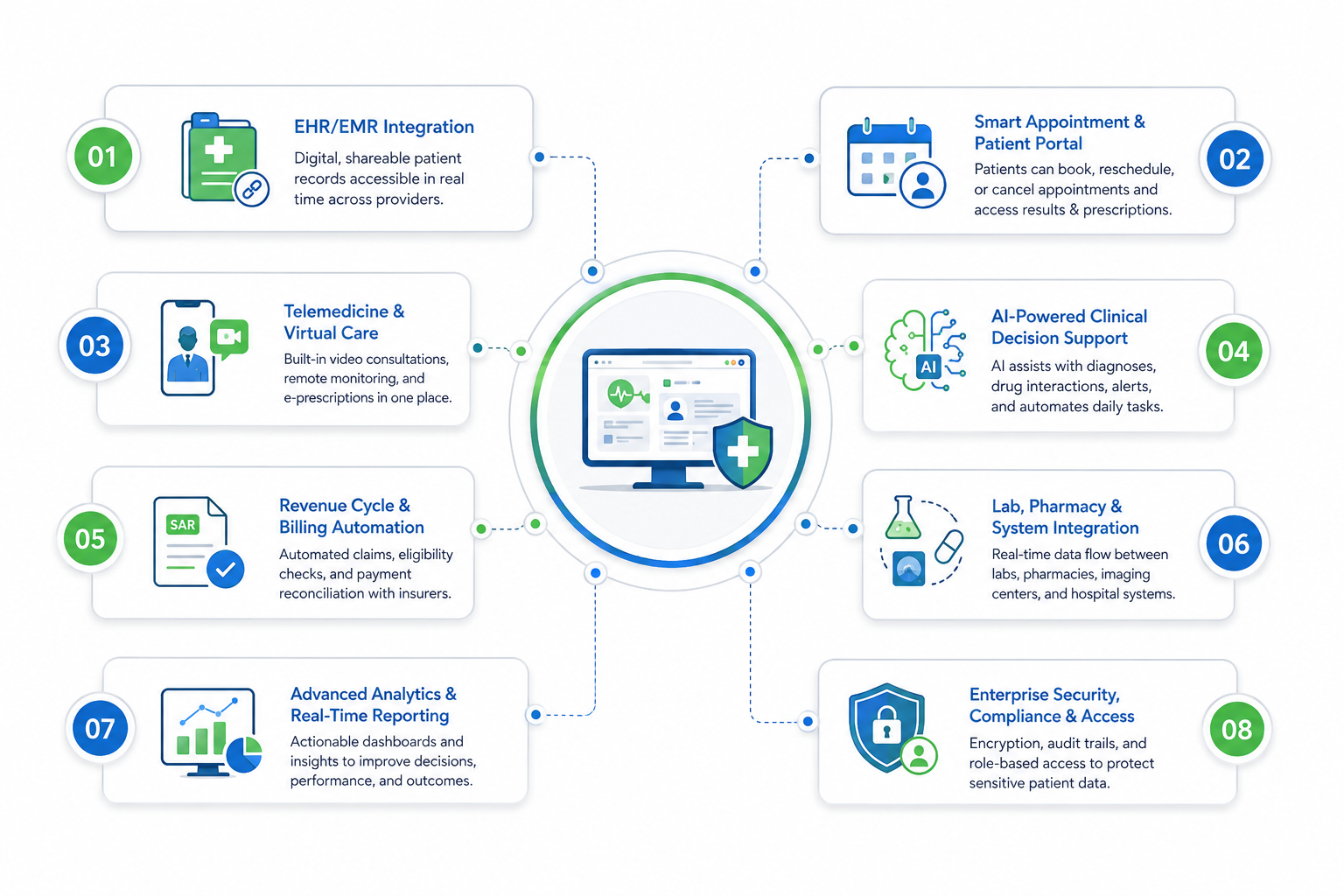
This is really the heart of the whole conversation, because a healthcare platform is only as good as what it can actually do for the people using it. Here's the detailed breakdown.
1. Electronic Health Records (EHR/EMR) Integration
What it is: A digital, shareable record of a patient's full medical history, connected across providers rather than locked in one clinic's database.
A good EHR integration does more than store data; it makes that data usable in real time. When a patient walks into a new clinic, the doctor should be able to pull up allergies, prior prescriptions, and lab history in seconds, rather than having to call the previous clinic and wait on hold. In an NPHIES-connected system, this also feeds directly into claims and eligibility checks, which reduces the endless back-and-forth insurers used to require.
The best EHR builds also support structured coding standards like ICD-10 and LOINC so that data means the same thing across every hospital it touches, not just the one that created it.
2. Smart Appointment Scheduling and Patient Portal
What it is: A self-service system where patients book, reschedule, or cancel appointments without calling anyone.
Honestly, this is the feature patients notice first and complain about loudest when it's missing. Smart scheduling should account for doctor availability, room capacity, and even predicted no-show rates, and then send automated reminders via SMS or app notifications. Pair it with a patient portal for test results and prescription refills, and you've removed a huge chunk of unnecessary phone traffic from the front desk.
3. Telemedicine and Virtual Care Support
What it is: Built-in video consultation, remote monitoring, and e-prescription tools inside the same platform patients already use.
Telemedicine works best when it isn't a separate app bolted on as an afterthought. It should live inside the same patient portal, pull from the same EHR, and route directly into the same billing and insurance workflow. Given how much of Saudi Arabia's virtual care infrastructure has scaled through the Seha Virtual Hospital model, this is quickly becoming table stakes rather than a differentiator.
4. AI-Powered Clinical Decision Support and Automation
What it is: Software that flags drug interactions, suggests diagnoses based on symptoms, and automates repetitive administrative tasks.
This is where things get genuinely exciting, and also where I'd push back a little on the hype. AI clinical support tools are useful for catching things a tired doctor at hour ten of a shift might miss: drug interaction warnings, abnormal lab flags, early sepsis risk scoring. But the goal should always be augmenting the clinician's judgment, not to replace it. The systems that get this balance right earn trust fast. The ones that don't get switched off within a month.
5. Revenue Cycle Management and Medical Billing Automation
What it is: Automated claims submission, eligibility verification, and payment reconciliation tied directly into national insurance systems.
Given that NPHIES processes health insurance claims using a mandatory Minimum Data Set covering diagnoses, procedures, medications, and claim values (source: Karger Publishers, Saudi Journal of Health Systems Research), any billing module built today has to speak that language natively. Automated eligibility checks alone can shrink pre-authorization times from what used to take one to two weeks down to a matter of days.
6. Laboratory, Pharmacy, and Third-Party System Integration
What it is: Real-time data flow between labs, pharmacies, imaging centers, and the core hospital system.
Nothing frustrates a patient more than waiting three extra days for a lab result that technically finished processing on day one; it just never made it into the right system. Integration closes that gap so results, prescriptions, and imaging reports move automatically to wherever they're needed next.
7. Advanced Analytics and Real-Time Reporting
What it is: Dashboards that turn raw patient and operational data into insights administrators can actually act on.
This is less about flashy charts and more about answering practical questions fast: Which department is over capacity this week? Which claims are getting rejected most often, and why? Good analytics tools surface that without someone manually pulling spreadsheets together every Sunday night.
8. Enterprise-Grade Security, Compliance, and Role-Based Access
What it is: Encryption, audit trails, and permission controls that ensure only the right people see sensitive patient data.
Healthcare data is about as sensitive as data gets. Role-based access means a receptionist sees scheduling info, not lab results, while a physician sees the full clinical picture. Combined with encryption and detailed audit logs, this isn't just good practice; it's a regulatory requirement under Saudi data protection rules.
Compliance and Regulatory Standards That Shape Healthcare Software in Saudi Arabia
The centerpiece of Saudi healthcare compliance right now is NPHIES, the National Platform for Health and Insurance Exchange Services. It's Saudi Arabia's central claims platform for mandatory health insurance, regulated by the Council of Cooperative Health Insurance. All provider-insurer claims flow through it, making integration essential for reimbursement (source: Bonami Software). Put simply: if a hospital's software isn't NPHIES-compliant, it can't get paid by insurers on time, and in some cases, at all.
NPHIES is built on HL7 FHIR R4 standards but with Saudi-specific profiles, meaning generic FHIR implementations from other countries usually need substantial rework before they'll pass Ministry of Health conformance testing. On top of that, providers need to handle National ID and Iqama-based identity matching, ICD-10-CM diagnosis coding, and the Saudi Billing Standard for invoicing.
Here's a fact worth sitting with: this isn't a "nice compliance feature" you add later. Vendors without proper NPHIES integration simply cannot sell health systems into the Saudi market at all. It's the entry ticket, not a bonus feature.
Emerging Technology Trends in Healthcare Software Development
A few trends are shaping where this market goes next.
- AI and predictive analytics are moving from pilot projects to actual clinical use, particularly around early diagnosis support and hospital capacity planning. Saudi Arabia established the Saudi Data and AI Authority to drive AI adoption and the strategic use of data, positioning itself as a regional AI leader in healthcare (source: Global Health Saudi). That's a strong signal about where investment is headed.
- Telehealth expansion continues to accelerate, especially for follow-up care and chronic disease management, reducing the need for patients to travel long distances for routine check-ins.
- Interoperability-first design is becoming the default rather than an afterthought, since every new system now has to plug into NPHIES from day one, rather than retrofitting it later.
- Cloud-based and mobile-native platforms are replacing legacy on-premise systems, partly because cloud infrastructure scales better for a growing population and partly because staff simply expect mobile access now.
Solid engineering underpins all of this, and that often comes down to fundamentals like clean Python Development for backend data processing or responsive JavaScript Development for the interfaces clinicians and patients interact with daily.

Build Secure and Scalable Healthcare Software for Saudi Arabia
Whether you need a hospital management system, telemedicine platform, EHR integration, or a custom healthcare application, TechWize delivers secure, compliant, and scalable healthcare software tailored to your business goals and Saudi healthcare regulations.
Talk to Our Healthcare ExpertsHow Much Does Healthcare Software Development Cost in Saudi Arabia?
Costs vary widely depending on scope, but a basic clinic management app can start in the tens of thousands of dollars, while a full hospital-grade, NPHIES-integrated HMS can run well into six or seven figures.
A few things drive that range up or down:
- Scope of the system - a single-clinic appointment app costs far less than a multi-hospital HMS with lab, pharmacy, and billing modules built in.
- NPHIES and FHIR integration complexity - building and certifying this properly takes real engineering time; it's not a plug-and-play API.
- Mobile vs. web vs. both - supporting native iOS and Android apps alongside a web dashboard naturally adds development hours.
- AI and analytics features - predictive tools and reporting dashboards add cost but also tend to deliver the clearest long-term ROI.
- Ongoing maintenance and compliance updates - regulations shift, and budgets should plan for continuous updates, not just a one-time build.
Rather than chasing the cheapest quote, it's usually smarter to budget around the features that directly reduce claim rejections and administrative overhead first, since those tend to pay for themselves fastest.
Why Choose TechWize for a Healthcare Software Development Company in Saudi Arabia
This is usually the part where a company oversells itself, so I'll keep it short. TechWize works on exactly this kind of build: custom healthcare platforms designed around Saudi compliance requirements from the ground up, rather than adapted after the fact. The focus stays practical: NPHIES-ready architecture, solid Software Testing before anything touches real patient data, and mobile and web experiences that clinical staff and patients actually want to use. If you're evaluating vendors for a healthcare build in the Kingdom, it's worth having that NPHIES-readiness conversation early, before development even starts.
Read Similar Blog
Top 8 Healthcare Software Development Companies in Australia
Explore More Software Development Insights ⬩➤Wrapping Up
Saudi Arabia's healthcare system isn't quietly digitizing anymore; it's doing it at a pace that's hard to ignore. Hospitals that treat software as an afterthought will feel that gap widen quickly, especially as NPHIES compliance and patient expectations both keep climbing. Whether it's a small clinic finally ditching its appointment book or a hospital group rebuilding its entire revenue cycle around real-time claims, the organizations that invest in the right foundation now are the ones that won't be scrambling to catch up later. The rest is really just a matter of picking the right starting point and building from there.
Frequently Asked Questions
What is Healthcare Software Development?
It's the process of designing, building, and maintaining digital systems, like EMRs, hospital management platforms, and telemedicine apps, that manage patient care, clinical data, and healthcare operations.
Why is NPHIES integration mandatory in Saudi Arabia?
Because all provider-insurer insurance claims in the Kingdom flow through NPHIES. Without integration, hospitals and clinics can't process claims or be properly reimbursed.
How long does it take to build a custom healthcare software solution?
A basic clinic management tool can take a few months to build. A full hospital management system with NPHIES integration, AI features, and multiple modules usually takes 6 months to over a year to implement, depending on scope.
Is telemedicine software legal and widely used in Saudi Arabia?
Yes. Telemedicine is actively supported under Vision 2030, with platforms like the Seha Virtual Hospital already serving hundreds of thousands of patients.
What makes healthcare software different from regular business software?
Mainly the compliance layer, patient data privacy, NPHIES claims requirements, and clinical accuracy all carry legal and safety weight that a typical business app simply doesn't have to deal with.