
 501, Fifth Avenue, Suite 805 New York, NY 10017
 info@techwize.com
 +1 (949) 887-0154
 TechWize
Here's a question worth sitting with for a second: when was the last time your sales, finance, and billing teams actually agreed on a number? For most companies, the honest answer is "not recently." Quotes live in one system, contracts in another, and billing gets figured out somewhere in between with a lot of Slack messages and crossed fingers.
That gap is exactly what Salesforce Revenue Cloud was built to close. And the timing isn't random. Salesforce officially moved its legacy CPQ product into End of Sale status in March 2025, which affected more than 6,000 existing customers who now have to plan their next move (source: servicepath). So this isn't a "someday" conversation anymore. For many RevOps and finance leaders, it's a this-year conversation.
What is Salesforce Revenue Cloud?
Salesforce Revenue Cloud is a single platform that manages the entire quote-to-cash journey, from the first product configuration to the final invoice. Unlike the old CPQ managed package, it's built natively inside Salesforce's core, which means it moves at the same speed as the rest of your Salesforce org instead of lagging a step behind.
Think of it this way: CPQ was a really useful add-on bolted to the side of your car. Revenue Cloud is the engine itself. It pulls together product catalog management, pricing, contracts, billing, and revenue recognition into a single connected system rather than five disconnected ones. That's a subtle difference on paper, but it changes almost everything about how quickly teams can actually move.
Why Businesses Are Turning to Salesforce Revenue Cloud Solutions
Businesses aren't adopting Revenue Cloud because it's the shiny new thing. They're adopting it because the old way of running revenue operations is starting to cost real money, in the form of slow quotes, billing errors, and finance teams who don't trust the numbers coming out of sales.
There's also a bigger shift happening underneath all of this. The subscription economy is projected to grow from roughly 628 billion dollars in 2026 at a 13.3 percent compound annual growth rate through 2033, and more than 60 percent of companies say they plan to convert at least one product into a subscription offering (source: Grand View Research, Marketing LTB). If your business is moving toward recurring revenue in any form, and honestly most are these days, you need a system that was actually designed for it. CPQ wasn't. Revenue Cloud was.
Salesforce Revenue Cloud Solutions provide teams with a single source of truth. Sales sees what finance sees. Finance sees what billing sees. Nobody's reconciling three spreadsheets at month-end anymore, or at least not for the reasons they used to.
Top Salesforce Revenue Cloud Features Businesses Should Know
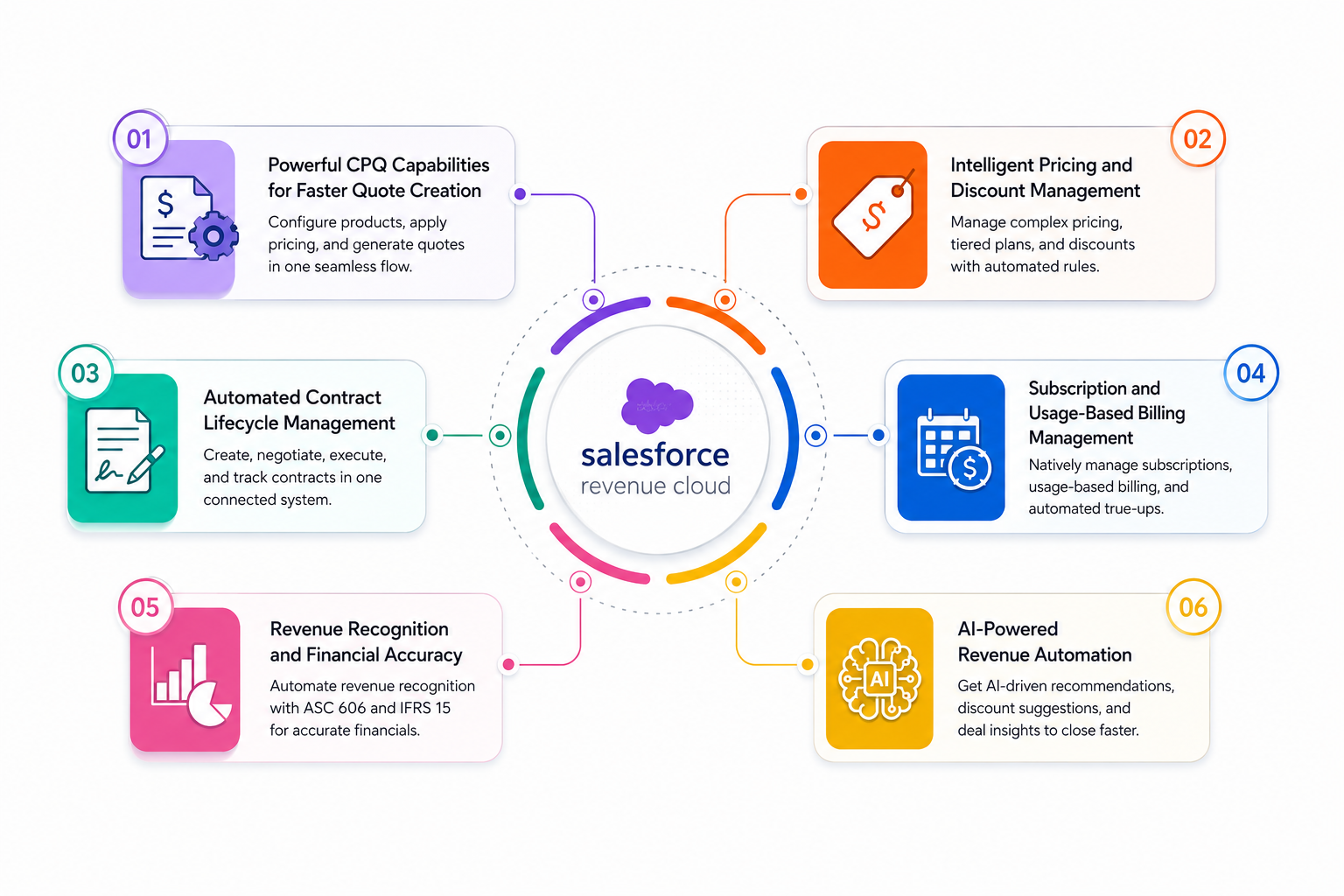
Powerful CPQ Capabilities for Faster Quote Creation
At its core, Revenue Cloud still does what CPQ used to do, just faster and with fewer workarounds. Sales reps configure products, apply the right pricing, and generate a quote in one continuous flow instead of jumping between tabs and approval chains.
What's actually different here is the native product catalog. It replaces the old configuration engine with one built directly on Salesforce's data model, so updates and customizations no longer require a specialist who knows the CPQ codebase inside and out. Here's the thing nobody really mentions when they talk about "faster quoting": the speed gain isn't just about the software being quicker. It's about not needing three approvals and a developer just to add a new product bundle.
Intelligent Pricing and Discount Management
Pricing gets complicated fast once you're dealing with tiered plans, volume discounts, and customer-specific deals. Revenue Cloud natively handles multi-dimensional pricing, so formula-based rules and complex discount logic no longer require custom code as they did in CPQ.
This matters more than it sounds. Pricing mistakes are quiet killers. A rep applies the wrong discount tier, nobody catches it until the invoice goes out, and now finance is chasing a correction. Automated pricing logic catches a lot of that before it ever becomes a problem.
Automated Contract Lifecycle Management
Contracts connect directly to quotes and orders in Revenue Cloud, which may sound like a small thing until you've spent an afternoon manually matching a signed contract to the quote it came from. Drafting, negotiation, execution, and renewal tracking all live in the same system, so there's a full trail from first conversation to signed deal.
For legal and deal desk teams, this means fewer version-control headaches and a much clearer picture of what was actually agreed to versus what got quoted six revisions ago.
Subscription and Usage-Based Billing Management
This is where Revenue Cloud really separates itself from legacy CPQ. Subscription models, whether monthly, annual, or usage-based, are natively supported, along with automated true-up billing for consumption pricing.
Given how fast subscription and usage-based models are growing across B2B software, this isn't a nice-to-have feature anymore. It's closer to table stakes. A platform that can't handle a mid-contract upgrade or a usage spike without a manual fix will fall behind pretty quickly.
Revenue Recognition and Financial Accuracy
Revenue recognition sounds like a finance-only concern until an audit surfaces inconsistencies that trace back to sloppy quote-to-cash handoffs. Revenue Cloud automates recognition in line with standards such as ASC 606 and IFRS 15, reducing the manual reconciliation work finance teams have historically had to do.
The real win isn't just compliance, though that matters plenty. It's that finance stops treating sales data with suspicion because the numbers come from the same system finance already uses.
AI-Powered Revenue Automation
Salesforce has been fairly direct about this: AI investment is going into Revenue Cloud, not legacy CPQ. That shows up as quote recommendations based on historical deal data, suggested discount levels that respect approval thresholds, and predictive flags on deals that look like they're stalling out.
This is one of the areas where Salesforce Agentforce plays a direct role, layering conversational AI and automated insights on top of the quoting and deal data already sitting inside Revenue Cloud.
Salesforce CPQ Services: How Revenue Cloud Compares to Legacy CPQ
If you're currently running CPQ, it's worth being clear-eyed about where things stand. CPQ still works. Nothing breaks the day after End of Sale. But feature development has effectively stopped, and the cloud-based CPQ market is still projected to grow 16 percent year over year, reaching nearly $5.8 billion in 2026, suggesting the market is moving toward modern platforms even as legacy CPQ sits still (source: crm.folio3.com).
Legacy CPQ was a managed package running on top of Salesforce, with its own object model and performance ceiling. Revenue Cloud is API-first and built directly on the core platform, so it inherits new Salesforce capabilities as soon as they ship, rather than waiting for a managed package update. That's the architectural difference in plain terms. One is renting space next to the platform. The other is part of it.
Working with experienced Salesforce CPQ Services providers during this transition matters more than most teams expect, mostly because migrating off CPQ isn't a simple lift-and-shift. It's closer to a rebuild, and rebuilds go a lot smoother with someone who's done it before.
Top Benefits of Salesforce Revenue Cloud for Modern Businesses
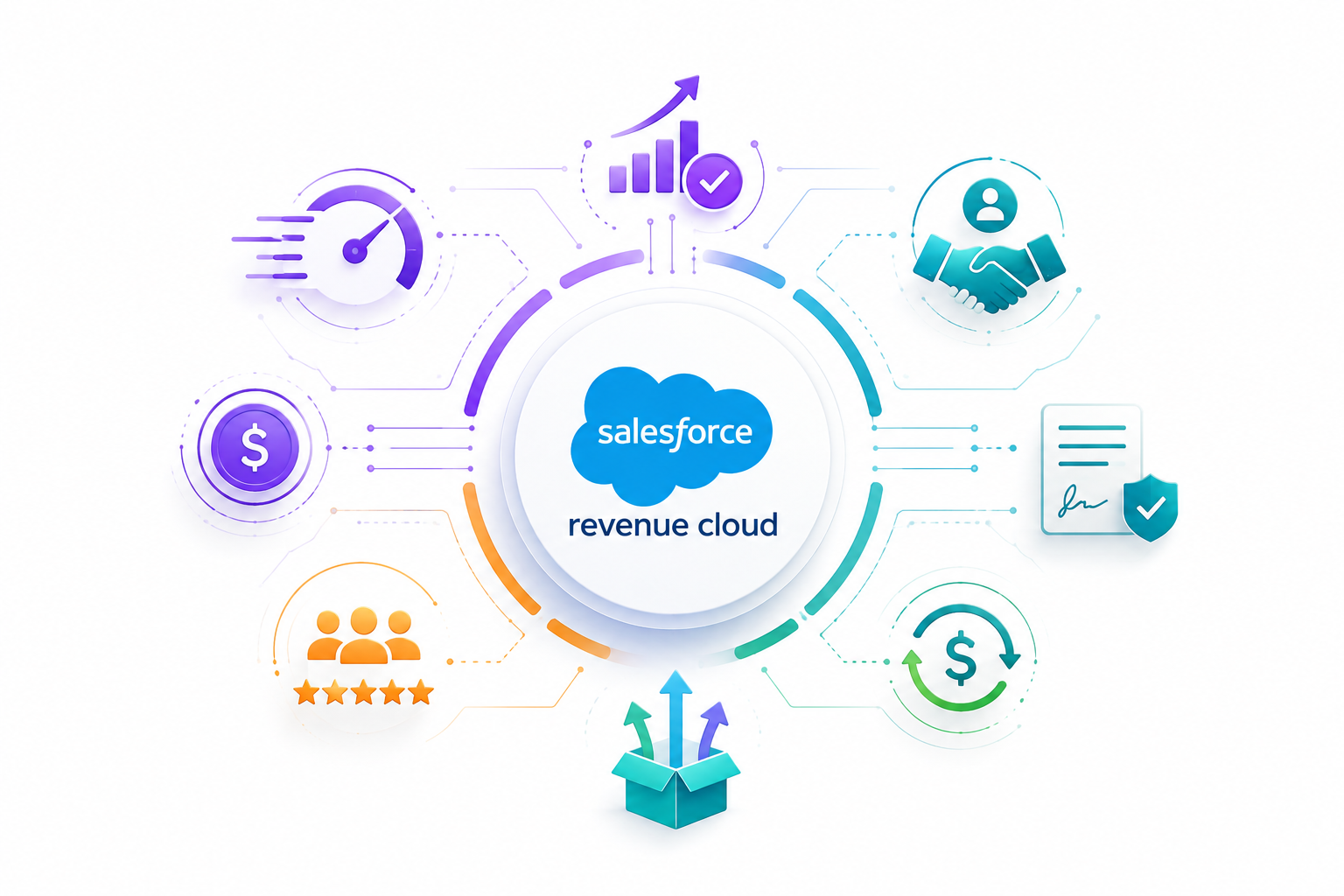
Faster sales cycles. When configuration, pricing, and approvals live in one flow instead of five disconnected steps, quotes go out faster and deals close sooner. That's not a marginal improvement. It compounds across every rep, every quarter.
Better sales and finance alignment. Shared data means sales and finance stop arguing about whose numbers are right. They're looking at the same numbers.
Increased revenue opportunities. Native support for upsells, cross-sells, and subscription add-ons means reps can act on expansion opportunities without waiting on a system that can't handle the change.
Improved customer experience. Customers notice when a vendor's quoting and billing process is a mess. Fewer errors and faster turnaround on their end means fewer awkward "we need to fix your invoice" conversations later.
Why Salesforce Revenue Cloud Implementation Requires Expert Support
Here's something worth saying plainly: Revenue Cloud implementation is not a weekend project, and treating it as one is probably the single biggest reason projects stall. Because there's no direct migration path from CPQ, teams end up rebuilding their quoting and pricing logic from scratch rather than simply moving data.
That process touches product catalog structure, pricing rules, approval workflows, and integrations with ERP or billing systems, often all at once. Get the sequencing wrong, and you end up with a system that technically works but doesn't match how your sales team actually sells. A proper Salesforce Revenue Cloud Implementation needs someone who's mapped this territory before, not someone learning the platform alongside your go-live date.

Ready to Move Off Legacy CPQ the Right Way?
Revenue Cloud implementation is not something to rush into under pressure on your own timeline. Talk to the TechWize team about mapping your current CPQ setup and building a Revenue Cloud rollout that actually fits how your sales team works.
Talk to Our Revenue Cloud TeamHow Salesforce Sales Cloud Enhances Revenue Cloud Performance
Revenue Cloud doesn't operate in isolation, and it shouldn't. Paired with Salesforce Sales Cloud Solutions, reps get a single connected view that runs from the first lead all the way through to a signed, billed contract, without switching tools or re-entering data along the way.
This pairing also opens the door to broader Salesforce capabilities worth knowing about, even if they're not the focus here. Sales Cloud (Agentforce Sales) brings AI-assisted selling directly into the same workflow reps already use for quoting. And for companies running marketing alongside sales, connecting to Marketing Cloud closes the loop between campaign activity and the deals that eventually show up in Revenue Cloud. Teams selling through digital storefronts sometimes extend this further with Commerce Cloud, tying online transactions back into the same quote-to-cash data model.
Why TechWize Is the Right Company for Your Salesforce Revenue Cloud Implementation
If all of this sounds like a lot to plan around, that's a fair reaction. It is a lot. This is where a team like TechWize tends to earn its keep, not by selling you on a platform you've already decided to adopt, but by handling the messier parts: mapping your current CPQ setup, sequencing the rebuild so sales isn't left without a working quoting tool mid-transition, and configuring pricing and approval logic that actually matches how your business runs day to day. It's the kind of implementation work that's easy to underestimate until you're the one doing it without help.
Read Similar Blog
10 Must-Have Features of Salesforce Agentforce Revenue Management Cloud for Modern Businesses (2026)
Explore More Salesforce Insights ⬩➤Build a Future-Ready Revenue Engine with Salesforce Revenue Cloud
CPQ got a lot of companies through the last decade just fine. But the ground has shifted, and platforms built for a subscription-and-AI world are pulling ahead of the ones that weren't. Revenue Cloud isn't a forced upgrade so much as it's what quote-to-cash looks like once the disconnected pieces finally start to talk to each other.
Whether that move happens this quarter or next year, the planning starts now. The businesses that treat this as a strategic rebuild rather than a rushed migration are the ones that will actually feel the difference in how quickly their teams move.